<home # start here # guides # builds # services # shop # about # categories>

The site lies on the central Golan Heights, east of the Sea of Galilee
Approximately 30–40 km east of the Jordan Valley. Roughly 80 km east of Haifa.
Rather than belonging to the Mediterranean woodland zone around Haifa or Upper Galilee, it occupies an elevated volcanic basalt plateau overlooking the Jordan Rift.
Unlike PPNA or PPNB villages:
Period Approximate Date
PPNA 9700–8800 BC
PPNB 8800–6500 BC
Gilgal Refaim 3500–3000 BC (Late Chalcolithic–Early Bronze Age)
A burial cairn was inserted into the center somewhat later, probably during the Early Bronze Age.
When Gilgal Refaim was constructed temperatures were slightly cooler than today, rainfall on the Golan was somewhat greater, oak woodland extended farther across the plateau and seasonal grasses supported extensive grazing
Today’s Golan remains relatively wet compared with much of Israel but has experienced: woodland reduction, agricultural expansion, soil erosion and warmer average temperatures during the last several millennia.
Was it a farming village?
Unlike Jericho or Gilgal I, archaeologists have found very little evidence of permanent domestic occupation. There are no substantial village deposits containing: houses, ovens, refuse middens and storage facilities. Instead, the monument appears to have served people living elsewhere.
Pistachio, almonds and figs
Because there was no excavated settlement, archaeobotanical remains are extremely limited. The surrounding natural vegetation likely included wild pistachio, almond, oak, hawthorn and terebinth. Wild figs probably occurred in lower valleys but there is no evidence that figs were cultivated at Gilgal Refaim itself. Unlike Gilgal I in the Jordan Valley—which produced the famous early domesticated fig remains—Gilgal Refaim has yielded essentially no comparable botanical assemblage.
Nearby Early Bronze Age communities certainly cultivated emmer wheat, einkorn wheat and barley
Surrounding Golan heights was ideal for sheep, goats and cattle
Most archaeologists believe the monument was built by pastoral-agricultural communities using the plateau seasonally.
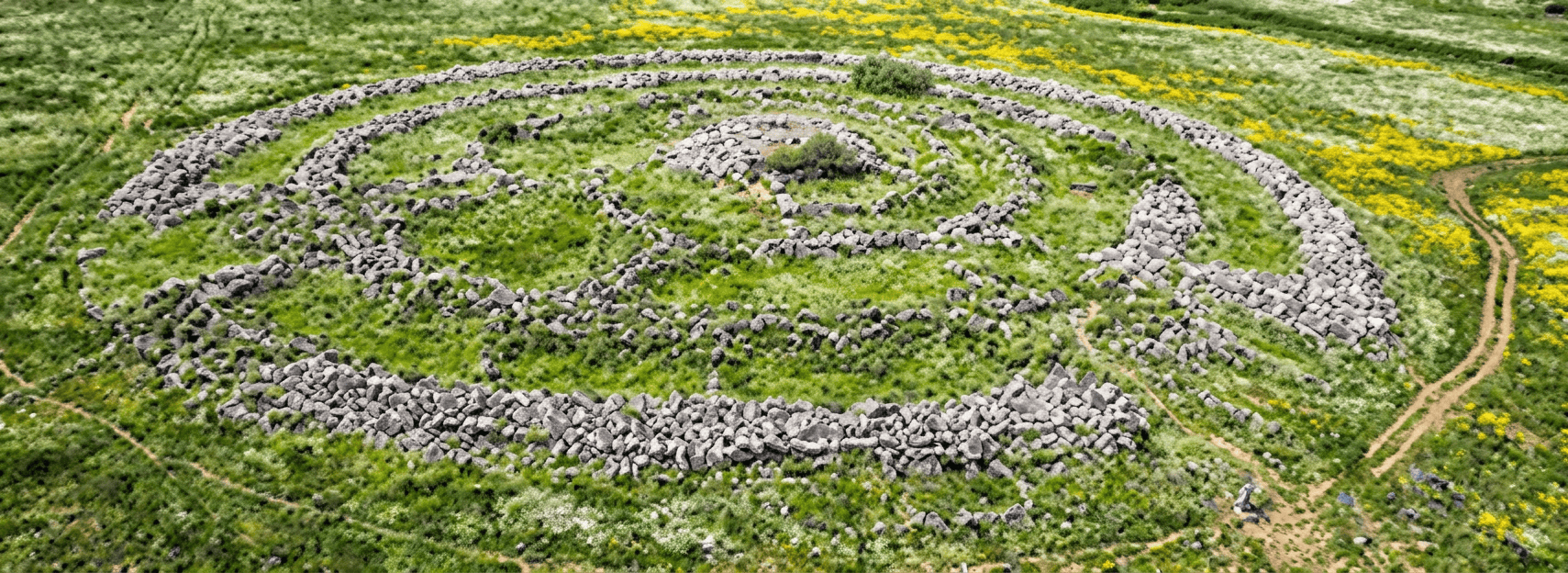
This is one of the largest prehistoric stone monuments in the Near Easta
The major features include five concentric basalt rings, radial connecting walls, central tumulus, diameter about 150–160 m and roughly 40,000 tons of basalt.
Unlike Stonehenge, there are no standing monoliths. Instead, builders stacked low dry-stone basalt walls.
Proposed interpretations include: ceremonial gathering place, mortuary landscape, ancestor monument, territorial marker and astronomical monument
The astronomical interpretation has become less certain as newer work questions earlier alignment hypotheses
The monument is remarkable because of: enormous concentric circles, sophisticated geometric planning, central burial cairn and massive basalt engineering.
It is often compared with European megalithic monuments, although it developed independently.
Unlike Neolithic villages that were rebuilt repeatedly, Gilgal Refaim appears to have been a concentric monument, with later addition of the central burial cairn and gradual abandonment. Check it out with some more neolithic architecture today.

References: Aveni, A., & Mizrachi, Y. (1998). The Geometry and Astronomy of Rujm el-Hiri, a Megalithic Site in the Golan.
Freikman, M., et al. Recent regional surveys of the Rujm el-Hiri landscape and associated circular monuments.
Kochavi, M. Early surveys and excavations of Rujm el-Hiri.
Mizrachi, Y. Excavation reports on Rujm el-Hiri. Cambridge University Press; and,
Radiocarbon Chronology of the Ancient Settlement in the Golan Heights Area, Israel. (Background on regional chronology.)
Leave a Reply