<home # start here # guides # builds # services # shop # about # categories>
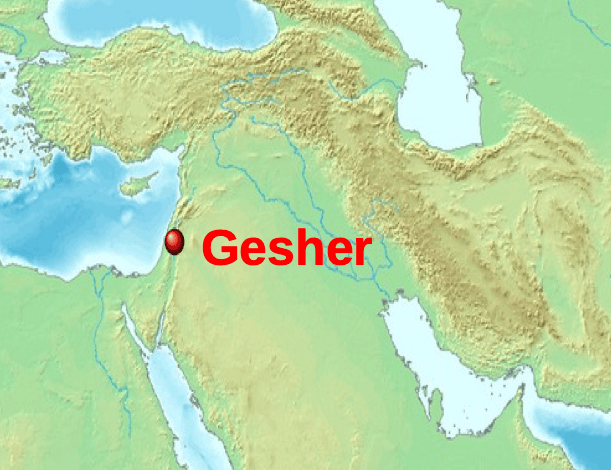
Gesher is one of the earliest known Pre-Pottery Neolithic A (PPNA) settlements in the southern Levant. Although much smaller than Jericho, it is archaeologically significant because it preserves evidence for one of the earliest permanent farming villages and contains what is probably the oldest known basalt tool workshop in the Near East. The settlement demonstrates that specialized craft production and exchange networks had already developed around 10,000 years ago.
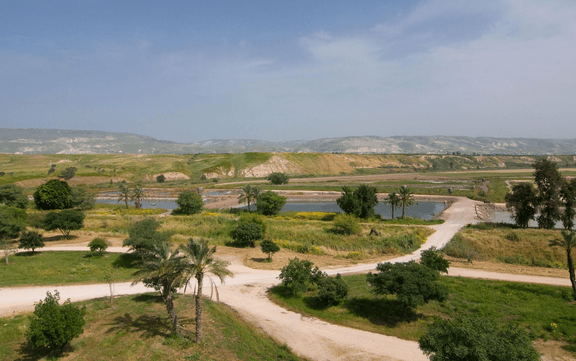
Gesher is situated in the central Jordan Valley, near modern Kibbutz Gesher
Approximately 100 km north of Jericho, 12 km south of the Sea of Galilee. It is 75 km east of Haifa and roughly 70 km southeast of Hayonim Cave.
Unlike coastal settlements such as Kfar Samir, or Atlit Yam, Gesher occupied a fertile inland valley close to rivers, springs, and floodplain soils.
Main occupation evidence is 8.3 to 7.8 thousand BC
With cultural affiliation to Khiamian or early Sultanian PPNA.
Thousands of years later, during the Middle Bronze Age (ca. 1900–1700 BC), the site was reused as a cemetery, but this was a completely separate occupation.
Environment
During the Early Holocene the Jordan Valley was cooler and wetter than today. It was a denser riparian woodland, and a richer diversity of wild plants and animals. It probably supported palestine oak, pistachio (Pistacia palaestina), terebinth, wild almond, wild fig, hawthorn, wild pear, willow and tamarisk along waterways and extensive reeds beside marshes.
Agriculture
Gesher belongs to the period when agriculture was emerging. Plant remains from comparable PPNA sites indicate cultivation or management of: einkorn wheat, emmer wheat and barley.
Wild resources were likely important, including pistachios, almonds, wild figs, acorns and wild legumes.
Direct archaeobotanical evidence from Gesher itself is relatively limited, but its economy appears comparable to other early Jordan Valley settlements such as Jericho and Netiv Hagdud.
Animals
Domestic animal husbandry was only beginning. Goats may have been under early management, but hunting remained extremely important.
Fish and wildlife resources included gazelle, wild boar, aurochs, deer, hare, birds and fish from the Jordan River.
Clear evidence for fully developed sheep and goat husbandry appears later during the PPNB.
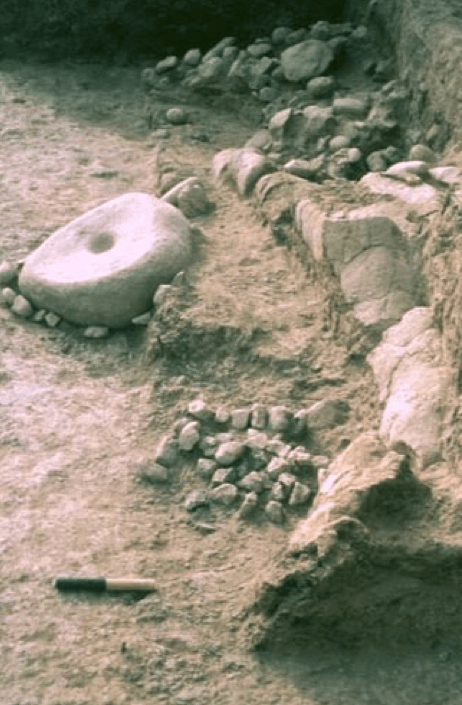
Architecture excavations revealed a small village composed of circular houses, semi-subterranean structures, mud walls, earthen floors, stone-lined installations and hearths
These rounded buildings resemble those at Jericho, Netiv Hagdud, and other early PPNA settlements. Unlike later PPNB villages, rectangular architecture had not yet developed.
No monumental communal building has been identified. Likewise, there is no tower. No large ceremonial building. No evidence comparable to Göbekli Tepe or Jerf el Ahmar.
Gesher appears to have been an ordinary farming village.
The site’s most remarkable discovery is its basalt workshop
Large quantities of basalt axes, grinding stones, hammerstones, unfinished tools and manufacturing debris show that Gesher specialized in producing basalt implements that were exchanged with other PPNA villages, including Jericho and Netiv Hagdud. This is among the earliest clear evidence for specialized craft production and regional exchange in the southern Levant.
No significant assemblage of anthropomorphic figurines has been reported
Unlike Sha’ar Hagolan or the Yarmukian culture, symbolic clay figurines are not a defining feature of Gesher. And, no convincing evidence for gaming pieces has been published.
Organic preservation is poor howerver numerous tools indicate woodworking activities
Polished basalt axes, flint adzes, blades and borers. These would have mostly been used for posts, roof timbers, digging sticks, furniture and tool handles.
Most tools were manufactured from local flint
El-Khiam points, projectile points, blades, sickle blades, scrapers, and burins. These help identify the site as an early PPNA settlement.
Weapons include El-Khiam arrowheads, hunting projectile points, flint knives and basalt axes
Gesher is especially important for: One of the earliest PPNA villages in Israel;
Earliest known basalt tool-production workshop in the Near East, (and, long distance exchanges);
Evidence for specialized craft production;
Well-preserved Khiamian flint assemblage;
Early evidence for regional exchange networks; and,
Archaeology and archaeobotany
The settlement demonstrates that specialized craft production and exchange networks had already developed around 10,000 years ago.
References: Belitzky, S., & Garfinkel, Y. (1996). Late Pleistocene and Holocene tectonic deformation at the Gesher site, Kinnarot Valley, Dead Sea Rift.
Garfinkel, Y. (1987). Gesher. Excavations and Surveys in Israel, 6, 54–55.
Garfinkel, Y. (1989). The Pre-Pottery Neolithic A Site of Gesher. Mitekufat Haeven (Journal of the Israel Prehistoric Society).
Garfinkel, Y., & Dag, D. (2006). Gesher: A Pre-Pottery Neolithic A Site in the Central Jordan Valley, Israel. Final Report. Ex Oriente.
Garfinkel, Y., & Nadel, D. (1989). “The Sultanian Flint Assemblage from Gesher and Its Implications for Recognizing Early Neolithic Entities in the Levant.” Paléorient, 15(2), 139–151.
Kuijt, I., & Goring-Morris, A. N. (2002). “Foraging, Farming, and Social Complexity in the Pre-Pottery Neolithic of the Southern Levant.” Journal of World Prehistory, 16(4), 361–440.
Bar-Yosef, O., & Belfer-Cohen, A. (1989). “The Origins of Sedentism and Farming Communities in the Levant.” Journal of World Prehistory, 3(4), 447–498.
Leave a Reply