< home # store # services # articles # game # app #contact >

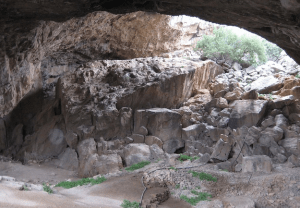
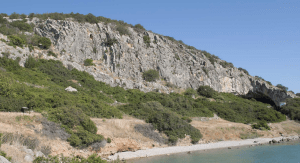
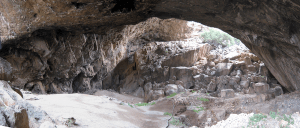
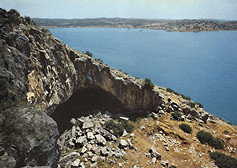
Last occupied around 3,000 BC (or, final neolithic), a major archaeological site overlooking Kiladha Bay, in the Argolic Gulf exists
Opposite the village of Kiladha, is in southeastern Argolis, Greece.

Humans first occupied the cave during the paleolithic era. Appearing around 38,000 BC (and possibly earlier) (1)
Groups continued to live in, or seasonally visit the cave. Throughout the Mesolithic and Neolithic eras. With occasionally apparent short episodes of abandonment.
Formal excavation history
In 1967, T. W. Jacobsen, a professor of classical archaeology and classical studies at Indiana University, began excavations at Franchthi Cave. The dig was only intended to temporarily occupy one short season.
It soon became clear that Franchthi Cave was more important than they anticipated
They kept going. Ending 10 years later, in 1976.
Since then numerous people have examined the finds. And, it is still being researched today.

Similar to some of the extreme weather we see today. During much of its history, Franchthi cave was different distances from the coastline
The sea levels have risen around 120 metres (400 ft). Inhabitants of the cave and area, looked out on a coastal plain that was constantly changing.
During the pleistocene, Franchthi Cave was probably seasonally occupied by a small group, or combinations
Probably in the range of 25 to 30 people. From the finds, they mainly hunted wild ass and red deer.
Its use as a campsite increased considerably after the last glacial maximum (LGM); or, 20,000 years ago
Obsidian from the island of Melos, and other nearby lithic tool sources, appear at Franchthi Cave. Which is some of the earliest evidence of ancient seafaring. Because they had to travel across the Aegean to get it. Franchthi cave offers some of the earliest evidence of navigation and boating skills by anatomically modern humans. (2)

Mesolithic: An blip in the occupation of Franchthi Cave occurred during the younger dryas climate cooling event
The world settled into a warmer holocene climate.
These periods are represented by only a few sites in Greece, and, like the Franchthi. Nearly all of them are close to the water, and coast.
It is believed that they did not rely as heavily on big game as their predecessors
They had different resources like a variety of small game, wild plants, fish and mollusks.
Implying deep sea fishing, there was a even a notable stretch spanning several hundred years, (circa 7,900 to 7,500 BC), when tuna became a major part of the diet
And, like other early neolithic or mesolithic cultures, graves were found buried in the cave. Suggesting health care and respect for the dead.
Neolithic: the cave contains some of the earliest evidence for agriculture in Greece
Remains of domesticated plants and animals are found among the usual wild plant and animal species. They hunted and gathered during the Mesolithic, and from before around 7,000BC. It is suggested they had begun to practice agriculture. Or, were trading seeds, meat, fish and crops with others.

There is debate about whether agriculture developed locally at the cave, was introduced or both
Though it is now generally believed that emigrants from the pre-pottery neolithic b, would have been introducing agriculture, and arriving on boats from the near east.
Mesolithic hunter-gatherers would have rapidly adapted to the Neolithic methods introduced, discovered or combined there
During the neolithic era, the main occupancy of the cave shifted to an area outside the entrance, called the Paralia, (or, the seaside)
They where terracing walls for growing crops, and, art and tool making areas. It was believed the inhabitants occupied an additional settlement below the Paralia. Which is now submerged beneath the sea.
Confirming this, several anthropomorphic and zoomorphic figurines were recovered from the cave
And, it has been suggested parts of the site, served as a workshop, for making cockle-shell beads. And, where they could trad with inland, and other communities.
The Franchthi area of Kiladha bay below, is a strong candidate for the submerged neolithic village
In 2012 a search was launched called the ‘Bay of Kiladha Project’, searching for underwater evidence. It was a collaboration between the University of Geneva and the Greek Ephorate of Underwater Antiquities. The divers revealed very old pottery fragments and odd seafloor anomalies.
By 2015, under a more thorough investigation, they found early ruins of a bronze age city Including foundations for buildings, stone paved surfaces, roads and the fortification of 3 large towers. The site spanned 3 acres; and, lies beneath 1 and 3 m (3 and 10 ft) of water.
Its defensive structure would be the first of its kind from the early bronze age in Greece. Being built around the same time as Newgrange, great pyrimids and many other significant structures.
What an amazing piece of prehistoric history!
Citation: (1) Douka, K.; Perles, C.; Valladas, H.; Vanhaeren, M.; Hedges, R.E.M (2011). “Franchthi Cave revisited: the age of the Aurignacian in south-eastern Europe”. Academia.
(2) N. Laskaris, A. Sampson, F. Mavridis, I. Liritzis, (September 2011) “Late Pleistocene/Early Holocene seafaring in the Aegean: new obsidian hydration dates with the SIMS-SS method” Journal of Archaeological Science, Volume 38, Issue 9, pp. 2475–2479
Bibliography: Douka, Katerina. “Douka, K., Perles, C., Valladas, H., Vanhaeren, M., Hedges, R.E.M. 2011. Franchthi Cave revisited: the age of the Aurignacian in south-eastern Europe. Antiquity 85 : 1131–1150”.
Farrand, William R. 1999. Depositional History of Franchthi Cave: Sediments, stratigraphy, and chronology. Fascicle 12 in the series Excavations at Franchthi Cave, Greece. Bloomington, Indiana: Indiana University Press. ISBN 0253213142. OCLC Number 41503459
J.M. Hansen (1992) “Franchthi Cave and the Beginnings of Agriculture in Greece and the Aegean.” Prehistoire de l’agriculture. Nouvelles approches experimentales et ethnographiques, CNRS, Paris pp. 231–47
T.W. Jacobsen, “Franchthi Cave and The Beginning of Settled Village Life in Greece” Hesperia 50:4, 1981 p. 306 http://www.ascsa.
Leave a Reply