< home # store # services # articles # game # app #contact >


Many European cave paintings from the upper paleolithic, or late pleistocene depict woolly rhino. And are perhaps the more memorable and favorite megafauna of Europe
Probably due to the red orches, and plants; rock and charcoil; and, fauna combinations that were available. The most famous drawings are found in the south eastern Czech Republic. An archaeological site known for bone fences and buildings called Dolni Vestonice. It is believe to have had up to 200 drawings of woolly rhino. Some scenes even dipicte rhinos fighting each other.
At another location, in Kapova cave, cave drawing images even show rhino struck with spears or arrows, vindicating there eventual demise
In France, Font de gaume, and Lascaux also had significant woolly rhino drawings.
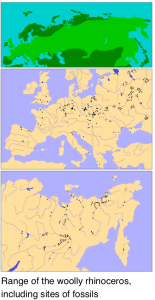
The hollow tooth lived 3,000,000, to 10,000 years ago, in and around Europe and Asia
Its size was quite large. Around 2000-3000 kg, or 4400 to 6600 lbs. It’s height was about 2 m (6.5 ft) tall at the shoulder, and up to 4.6 m (15 ft) in total body length.
There were some amazing features to minimize heat loss. A longer head and body, and shorter legs Its shoulder, a powerful thick hump where it had stored fat cells. It also had shorter ears and tail. And, its skin was thicker.
Compared to modern rhinos, there horns were quite large, and faced forward
They were around 1 meter (3.3 feet) to about 1.4 (4.7 feet). There individual weight reached up to 35 lbs.

It was documented that more and more woolly rhino were found around the mid 1700s
Scientifically and archaeologically speaking, it was an exciting time. Russians were releasing data, and that someone was brave enough to explore Kapova cave. And, further east scientists were uncovering remains in the permafrost.
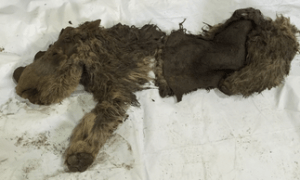
A big find was in 1907 when Russian miners announced they had found a complete frozen skeleton buried in a ozokerite pit
In the 1910s, 20s, and 30s, scientists continued on looking for, and analyzing remains. Many had claimed the woolly rhino had secret powers. They feared it had a similar resemblance to a dragon or mythical creation. By the 1930s numerous specimens were found. Many can now be found at: the Lviv National Museum in Russia, the Natural History Museum in Kraków (Poland), and, Natural History Museum in London.
In the past 20 years, permafrost has continued to melt. An additional 3-5 complete woolly rhinosaurus skeletons have been found(1)(2)
Scientists are already looking at bringing the woolly mammoth back. Maybe one day they will bring the‘hollow tooth of antiquitity’.

With its large horns, the ceolodonta antiquitatis would have used them for battle, uncovering food and mammoth steppe; and, to attract mates
When they did mate, its believed calves were raised similarly to white and black rhinos. Two titties on the females indicated 2-3 offspring were commonly raised at a time. If similar to modern rhinos, the young reached sexual maturity in 5 years, and would go out on there own around 3. Because of there size, adults had few predators. Though unless still maturing, it was the young that had to fend off hyenas, cave lions, and human predators.
They often lived to 40 years(3)
The rhinos liked lowlands, river valleys, and plateaus with dry to arid climates. If necessary they could migrate higher but not if the snow was too deep
In combination: giant deer, mammoth, reindeer, saga antelope and bison formed what some scientist call the mammothus-ceolodonta faunal complex.

Did you know? In arctic Siberia, half meter spear throwers (atlatls) were found carved from w. rhino horns. The Yana paleolithic site is one of the pleistocenes most interesting. Not just because of this but because of its northern location.
The woolly rhinos mostly fed on mammoth steppe. A plant vegetation diet was very common: grasses, flowers, forms and mosses. There wide upper lip easily pluck pieces from ground
In the winter, it also ate woody plants, conifers, willows and alder. Because of the low protein calories. For nutrition, they would eat massive amounts of grasses and food.
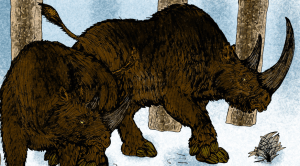
Around 130,000 years ago, it was believed the woolly rhino had the widest range of all rhino species. Though seemingly it did not cross the Bering land bridge (at least in large numbers)
It was probably due to low grass density, and having to compete with the larger mammoth, humans and different faunal complexs.
Did you know? Sites in Gudenus cave (Austria); and, open air site at Konigsaue, Germany had heavily beaten bones, with slash marks. It could have been partially from humans taking the marrow for nutrients and lantern fat. Also, making weapons, tools, and art.

Though it is widely debated. It is believed depletion of the pleistocene megafauna habitat. The loss of glacier, ice and mammoth steppe eventually contributed to the decline of the woolly rhino. Humans hunting, natural disasters and climate change would also would have contributed to there loss. So, lets hear it for the ceolodonda antiquitatis, or ‘hollow tooth of antiquitity’, bearing resemblance to the fancy northern tradition you see today.
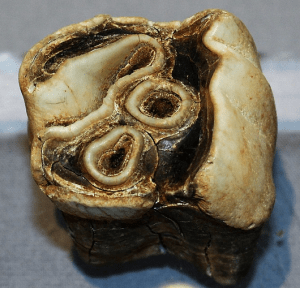


coelodonta antiquitatis woolly rhino sticker
Found in Europe and Asia, the woolly rhino is paying homage to greek and Europeon tradition as ceolodonta antiquitatis or “hollow-tooth of antiquity”
Cite: 1) Liesowska, Anna. “Meet Sasha – the world’s only baby woolly rhino” (https://siberiantimes.com/science/casestudy/news/n0129-meet-sasha-the-worlds-only-baby-woolly-rhino/). The Siberian
Times.
2) “Woolly rhino from Ice Age unearthed in Russian Arctic” (https://www.bbc.co.uk/news/world-eur
ope-55490037). BBC News. 30 December 2020.
3) Garutt, N.V. (1997). “Traumatic skull damages in the woolly rhinoceros, Coelodonta antiquitatis Blumenbach, 1799” (http://www.rhinoresourcecenter.com/pdf_files/142/1428276474.pdf)(PDF). Cranium. 14 (1): 37–46.
Bibliography: Uzunidis, A.; Antoine, P.-O.; Brugal, J.-P. (2022). “A Middle Pleistocene Coelodonta antiquitatis praecursor Guérin (1980) (Mammalia, Perissodactyla) from Les Rameaux, SW France, and a revised phylogeny of Coelodonta Bronn, 1831″. Quaternary Science Reviews. 288. 107594. doi:10.1016/j.quascirev.2022.107594.
Dale Guthrie, R. (1990). Frozen Fauna of the Mammoth Steppe. ISBN9780226311234.
Shpansky, A.V. (2014). “Juvenile remains of the “woolly rhinoceros” Coelodonta antiquitatis (Blumenbach 1799) (Mammalia, Rhinocerotidae) from the Tomsk Priob’e area (southeast Western Siberia)” (PDF). Quaternary International. Elsevier BV. 333: 86–99. Bibcode:2014QuInt.333…86S. doi:10.1016/j.quaint.2014.01.047. ISSN1040-6182
Price, Samantha (2007-06-01). “Horns, Tusks, and Flippers: the Evolution of Hoofed Mammals” (PDF). Aquatic Mammals. Aquatic Mammals Journal. 33 (2): 254. doi:10.1578/am.33.2.2007.254. ISSN0167-5427. S2CID127893230. Archived from the original (PDF) on 2019-12-08
Leave a Reply