< home # store # services # articles # game # app #contact >

The modern cat (felis silvestris catus) is descended from one or more, of four or five separate wild cats:

The Sardinian wildcat (Felis silvestris lybica);

European wildcat (F. s. silvestris);

Central Asian wildcat (F.s. ornata);

Sub-Saharan African wildcat (F.s. cafra); and,

Perhaps, the Chinese desert cat (F.s. bieti).

The domestication refers to the process by which they were tamed. And, selectively bred over generations. To live alongside humans, in a domestic setting.

To identify, archaeologists have relied on the size of animal bones found in archaeological sites
Domesticated cats were smaller than feral or native cats. It has also been based on there location and ranges. If they are given burials or collars. And, if they were able to establish a proximity for the type/species. As well, it is also noted, if they established a commensal relationship with humans. Like if they were buried together.
Two problems
Domesticated cats can and do interbreed with feral (native ones). And, it’s not easy to identify using archaeology. Indicators of domestication include interaction and socialization. Traits not easily identified using the history record.
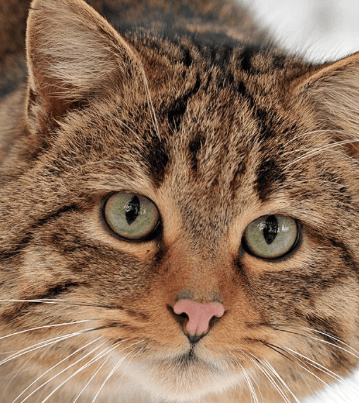
The oldest evidence for cats living with humans is from the Mediterranean island of Cyprus
At the neolithic site of Shillourokambos, is the earliest known cat burial site. From around 10,000 years ago. There are a few ceramic figurines from around 7000 years ago too. At the site of Hacilar, in Turkey. They’re is shaped women carrying cats or, women with cat like figures in their arms.


Recent evidence of cats in China, during middle late Yangshao (5000-3000 BC)(1)
Perhaps as long ago as 5,000 years. The presence of F. silvestris in neolithic China supports the growing evidence of complex trade and exchange routes connecting western Asia, to northern China.
In 2014, there is also evidence of early cat-human interactions at the site of Quanhucun. In Shaanxi province, China
Eight F. silvestris cat bones were recovered from three ashy pits. Animal bones, pottery sherds, bone and stone tools were found here too. In close proximity.

Over time, humans likely tolerated the presence of these cats because of their pest-control abilities
As the relationship between cats and humans evolved, some cats became more comfortable living in close proximity to people. This may have led to a gradual process of self-domestication. Cats with more favourable traits for cohabitating with humans were more successful and passed on their genes.
Over a long period of time, humans begin select cats with desirable traits. It lead to the development of different breeds with specific characteristics. Today, they serve various roles as companions, pest controllers, and even show animals. Giving us all, the diverse appearance, and behaviour you see today.
Cite: 1) Hu Y, Hu S, Wang W, Wu X, Marshall FB, Chen X, Hou L, and Wang C. 2014. Earliest evidence for commensal processes of cat domestication. Proceedings of the National Academy of Sciences 111(1):116-120.
Bibliography: Serpell, James A. (2013), “Domestication and history of the cat”, in Turner, Dennis C; Bateson, Patrick (eds.), The Domestic Cat, Cambridge University Press, pp. 83–100, doi:10.1017/cbo9781139 ISBN 9781139177177
Driscoll, Carlos (2009). “The Taming of the Cat. Genetic and Archaeological findings hint thatwildcats became housecats earlier- and in different place- than previously thought” (https://www.ncbi.nlm.nih.gov/pmc/articles/PMC5790555). Scientific American. 300 (6): 68–75. Bibcode:2009SciAm.300f..68D (https://ui.adsabs.harvard.edu/abs/2009SciAm.300f..68D). doi:10.1038/scientificamerican0609-68 (https://doi.org/10.1038%2Fscientificamerican0609-68). PMC 5790555 (https://www.ncbi.nlm.nih.gov/pmc/articles/PMC5790555). PMID 19485091 (https://pubmed.ncbi.nlm.nih.gov/19485091)
Leave a Reply