< home # store # services # articles # game # app #contact >


In the early 1960s, the great plains museum learned about a possible clovis site, from a local
The local reported finding bones protruding from an eroding bank of the Tonkawa Creek. These bones included portions of a mammoth skull, tusk, and vertebrae. What they found was a strong clovis site, where mammoth remains along with projectile points and other stone tools were found. The site provides evidence of clovis people hunting large Pleistocene animals, specifically mammoths.

The hunters used the stratigraphy or terrain to an advantage
Mammoth were driven into the soft alluvium sediment of the Canyon. Where they would become exhausted or stuck. Making for an easier kill.
Archaeologists unearthed remains of mammoth; and, projectile points were found
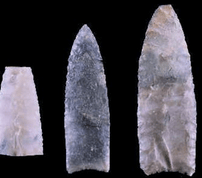
The occurrence of rib bones under the pelvis suggested purposeful disarticulation by the hunters. The discovery of both the mammoth bones and tools in a single location strongly suggests that the site was used as a hunting or kill site. Where hunters would have processed animal for meat, hide, and possibly other resources. The tools were finely crafted with fluting and flaking characteristic of Clovis technology.
Did you know? 8 species of freshwater snails, twenty-one species of land snails, and two species of small freshwater clams were present in the area at the time. Including: Freshwater gastropods (Valvata tricarinata, Lymnaea caperata, Lymnaea dalli, and Gyraulus parvus); Land gastropods (Stenotrema leai aliciae, Vertigo ovata, and Vallonia); freshwater snails; and, Land snails (gracilicosta).
Domebo Canyons significance lies in its direct evidence of human and megafauna interaction. It is part of a group of Clovis “kill sites,” which have yielded similar evidence of large-game hunting by Clovis people.
In addition to its archaeological importance, the site also provides insight into the environment importance of pleistocene Oklahoma. It was not just home to large mammals but also to humans and other species. The findings at Domebo Canyon help solidify that Clovis groups were capable people. They were able to adapt sophisticated tools and techniques to the resources available to them at the time. During the last Ice Age.
Bibliography: “Oklahoma’s Past: Caddo County, The Domebo Canyon Site” (http://www.ou.edu/cas/archsur/counties/caddo). Oklahoma Archaeological Survey.
Leonhardy, Frank (1966). Domebo: A Paleo-Indian Mammoth Kill Site in the Prairie-Plains. Lawton, Oklahoma: Great Plains Historical Association.
Leave a Reply