< home # store # services # articles # game # app #contact >

Algeria. The second largest country in Africa. And, the largest on the Mediterranean sea. One of its main places. Djelfa is in a transitional zone. It is between the dry, steppe-like hautes plaines (high plateaus) of the north. Where it is characterized by chotts (intermittent salt lakes). And, the Sahara to the south.
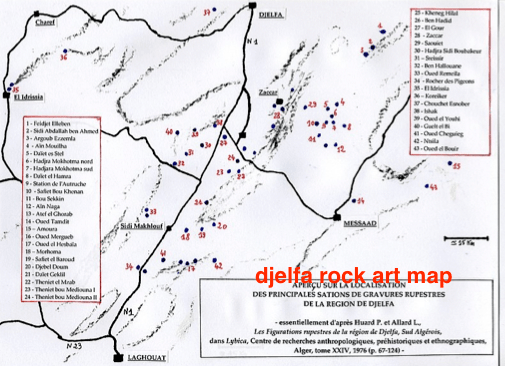
The area is notable for its abundance of neolithic rock carvings. Dating from around 7000 to 5000 years ago
Rock engravings, and petroglyphs include: animals, human figures, and abstract symbols
They are depicted are a number of scenes. And that provide insights into the cultural and spiritual lives of these neolithic peoples.
According to explorer and author Henri Lhote; wikipedia; and, others. Large wild fauna: ancient buffalo, hartebeest antelopes, elephants, rhinoceros, lions, ostriches and human figures are represented
There are also weapons and men under animal skins and masks
Bows; long and curved weapons, clubs, hatchets; shields; and, traps are recorded
Several animals like cattle, sheep and antelope carry signs of domestication as well
Especially collars. And, their is representation of Sheppard’s

There is evidence of megalithic structures too
These (dolmens and stone circle) were likely burial sites, ceremonial locations, or markers of territorial boundaries.
Tools, and many artifacts have been found. Suggesting agriculture, animal husbandry, hunting and more
There is architectural evidence of dwellings and communal spaces. And, a more permanent shift to habitation.
Providing a window of change and to early human occupation of north Africa. Neolithic Djelfa contributes to our understanding and development of neolithic architecture. Which saw the farming, social complexity, technological innovation and art develop into what we have today.
-
 Algerian neolithic women t-shirtPrice range: $60.00 through $70.00
 -
 ostrich egg drinking glass$14.00
Bibliography: Flamand, G.B.M., Deux stations nouvelles de pierres écrites découvertes dans le Cercle de Djelfa, in “L’Anthropologie”, XXV, 1914 (pp. 433–458)
François de Villaret, Siècles de steppe, Jalons pour l’histoire de Djelfa, Centre de Documentation Saharienne, Ghardaia (Algérie), 1995.
Grébénart D., Aïn-Naga. Capsien et Néolithique des environs de Messad (département de Médéa), dans “Lybica”, XVII, CRAPE, Alger, 1969 (pp. 135–197)
Flamand, G.B.M., Les Pierres écrites, Paris, Masson, 1921 (pp. 314–318).
Vaufrey, R., L’Art rupestre nord-africain, Paris, Masson, 1939.
Bellin, P., L’art rupestre des Ouled Naïl, in “Bull. Sté préhist. franç.”, LIV, fas. 5-6, mai-juin 1957 (pp. 299–330).
Tixier, L., Gravures rupestres de Bou Saâda (Algérie), in “Bull. Soc. royale belge d’études géol. et archéol.”, XVII, 1958-1960 (pp. 21–27).
Lethielleux J., Vestiges préhistoriques et protohistoriques de la région de Djelfa, dans “Lybica”, XII, CRAPE, Algiers, 1965.
Lefebvre G., La station rupestre de Daïet es Stel, in “Lybica, tome XV, CRAPE, Alger, 1967 (pp. 207-213).
Grébénart D., Aïn-Naga. Capsien et Néolithique des environs de Messad (département de Médéa), dans “Lybica”, XVII, CRAPE, Alger, 1969 (pp. 135–197).
Syndicat d’Initiative de Djelfa, Dans les monts Ouled Naïl, in “El Djezaïr, n° 13, Alger, 1970 (pp. 42–48).
Camps, G., Les Civilisations préhistoriques de l’Afrique du Nord et du Sahara, Paris, Douin, 1974.
Huard P. et Leclant, Recherches sur la culture des chasseurs anciens du Nil et du Sahara, CRAPE, Algiers, 1977 (?).
Aumassip, Ginette, Trésors de l’Atlas, Alger, Entreprise nationale du Livre, 1986.
Colette Roubet, Iddir Amara, From art to context: Holocene roots of an Initial Neolithic Pastoralism (INP) in the Atlas Ouled Naïl, Algeria,
Quaternary International, Volume 410, Part A, 2016, Pages 103-122, ISSN 1040-6182, https://doi.org/10.1016/j.quaint.2015.08.060.
(https://www.sciencedirect.com/science/article/pii/S1040618215008381)
Leave a Reply