<home # start here # guides # builds # services # shop # about # categories>

Long before the pyramids of ancient Egypt, pastoral communities gathered around seasonal lakes in the western deserts of northeastern Africa. At a site known as Nabta Playa, archaeologists uncovered stone circles, alignments, ceremonial structures, and evidence for cattle-focused ritual practices dating between approximately 6000 and 4000 BCE.
Since their discovery, these remains have sparked debate among archaeologists, astronomers, and historians. Some researchers argue that the site contains one of the world’s earliest known astronomical complexes—a prehistoric observatory designed to track stars, solstices, or seasonal cycles. Others caution that such interpretations may overstate the evidence and risk projecting modern ideas onto ancient societies.
The central question remains: did the builders of Nabta Playa intentionally create a cosmological landscape, or are some of the proposed astronomical alignments simply coincidences? The answer likely lies somewhere between these extremes.
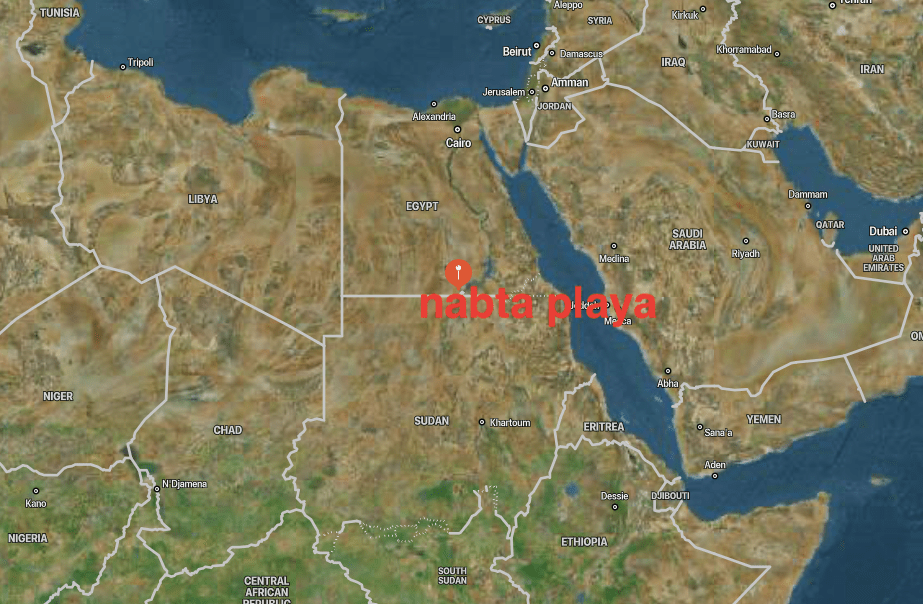
Where Is Nabta Playa?
Nabta Playa lies in the Nubian Desert of southern Egypt, roughly 100 kilometers west of Abu Simbel. Today the area is arid desert, but conditions were very different during the early and middle Holocene. Between approximately 9000 and 5000 BCE, increased rainfall transformed parts of the Sahara into grasslands dotted with seasonal lakes and wetlands. These favorable conditions supported herding communities, seasonal settlements, hunting activities, ritual gatherings and long-distance interaction networks. Nabta Playa emerged as one of the most important ceremonial landscapes of prehistoric North Africa.

The Stone Circle
Among the site’s most famous features is a small stone circle constructed around 4800–4500 BCE. Unlike later megalithic monuments such as Stonehenge, the Nabta Playa circle is relatively modest. It consists of upright stone slabs, internal stone arrangements, carefully positioned alignments, associated ceremonial structures nearby, its significance lies not in its size but in its apparent precision. Researchers noticed that some stones seem oriented toward particular directions associated with celestial events. This observation gave rise to theories that the monument served an astronomical function.
The Astronomy Hypothesis
One influential interpretation proposed that the stone circle helped track seasonal solar events. For pastoral societies living in an environment dependent upon rainfall, accurately anticipating seasonal changes would have been extremely valuable. Potential uses include predicting rainy seasons, coordinating movement of herds, scheduling communal gatherings, timing rituals and organizing resource management. Some researchers have argued that alignments within the circle correspond to summer solstice sunrise positions, cardinal directions and prominent stars visible at the time. If intentional, this would represent remarkably early evidence of systematic sky observation.

Did People Track Stars?
More controversial claims suggest that certain stone alignments were designed to monitor specific stars or constellations. Proposed candidates have included sirius, orion-related stars and bright southern stars visible during the Holocene. Supporters argue that repeated observations of the night sky could have helped pastoral groups track seasonal changes. The appearance and disappearance of bright stars often coincide with annual environmental cycles. For societies without written calendars, the sky functioned as a reliable clock. However, many archaeologists remain cautious. Unlike later Egyptian texts, Nabta Playa provides no written evidence explaining the purpose of the alignments. As a result, star-tracking interpretations remain hypotheses rather than proven facts.
Coincidence or Intention?
This question lies at the heart of the debate. When examining ancient monuments, researchers must distinguish between (intentional alignment, functional alignment and statistical coincidence).
Intentional Alignment. Builders deliberately positioned structures toward celestial targets.
Functional Alignment. Structures happen to face certain directions because of practical considerations.
Statistical Coincidence. Some alignments occur purely by chance. Given enough stones and enough stars, accidental correspondences inevitably appear.
This problem is known in archaeology as the issue of “selection bias.”
Researchers may notice successful alignments while overlooking countless others that do not fit a theory. For this reason, modern archaeological standards require multiple lines of evidence before concluding that a monument had an astronomical purpose.
The Case for Intentional Cosmology
Despite these cautions, several factors suggest that celestial symbolism may have played an important role at Nabta Playa (repeated orientation patterns, ceremonial construction, environmental dependence and ritual context)
Repeated Orientation Patterns. Certain alignments appear consistently across different features. Repeated patterns are less likely to result from chance alone.
Ceremonial Construction. The monuments required collective labor and planning. Communities rarely invest significant effort into structures without social or symbolic importance.
Environmental Dependence. Pastoral groups depended heavily on seasonal rainfall. Monitoring celestial indicators would have had practical value.
Ritual Context. Many structures appear ceremonial rather than domestic, suggesting symbolic or religious functions.
Together, these factors strengthen the possibility that sky observation played some role in site activities.

Cattle and Cosmology
One of the most important discoveries at Nabta Playa involves cattle. Archaeologists uncovered cattle burials, ceremonial deposits, special treatment of animal remains and monumental structures associated with livestock. These findings suggest cattle held symbolic significance beyond their economic value. Some researchers describe this as an early cattle cult.
The term does not imply organized religion in the modern sense. Instead, it refers to ritual practices centered on cattle as socially and spiritually important animals. Cattle provided food, milk, social status, mobility and wealth. In many pastoral societies worldwide, livestock become powerful symbols of identity and community. At Nabta Playa, cattle may have occupied a similar position.
Connecting Sky and Herds
The most intriguing possibility is that astronomy and cattle symbolism were interconnected. Pastoral communities relied on environmental cycles. Successful herding depended upon rainfall, grazing conditions, seasonal migration and water availability. If celestial observations helped predict these cycles, then the sky itself may have become integrated into ritual life. The relationship could have looked something like this: Sky observation → Seasonal prediction → Herd management → Community survival. Over generations, practical knowledge may have acquired spiritual meaning. What began as observation could have evolved into cosmology.
Architecture as a Cosmological Tool
Nabta Playa reminds us that architecture is not always about shelter. Many prehistoric monuments served symbolic purposes. Their functions included marking sacred places, organizing communal gatherings, expressing identity, recording knowledge and connecting people with landscapes. If astronomical interpretations are correct, the stone structures at Nabta Playa may represent one of humanity’s earliest attempts to embed cosmic understanding into architecture. The site would then stand among the first examples of a designed sacred landscape.

What Most Archaeologists Agree On
Although debates continue, there is broad agreement on several points. Nabta Playa demonstrates sophisticated planning, organized communal activity, symbolic behavior, ritual treatment of cattle and monumental construction before dynastic Egypt. Most archaeologists also agree that the site’s builders possessed detailed environmental knowledge.
Whether this knowledge extended to systematic astronomy remains an active area of research. The strongest position today is neither complete acceptance nor complete rejection of astronomical interpretations. Instead, many scholars conclude that some alignments were probably intentional, while more ambitious claims require additional evidence.
Nabta Playa occupies a unique place in prehistoric archaeology. Built between roughly 6000 and 4000 BCE, its stone circles, alignments, ceremonial structures, and cattle burials reveal a society capable of sophisticated planning and symbolic thought.
Did its builders practice astronomy? Quite possibly. The evidence suggests that celestial observations may have helped pastoral communities understand seasonal cycles and organize ritual activities. However, claims of precise star tracking or fully developed astronomical systems remain difficult to prove.
The most convincing interpretation may be that Nabta Playa represents an early cosmological landscape—one in which practical environmental knowledge, ritual behavior, cattle symbolism, and observations of the sky became increasingly interconnected.

Whether viewed as an observatory, ceremonial center, or sacred gathering place, Nabta Playa reminds us that long before written history, humans were already seeking to understand their place within both the landscape and the cosmos.
References: Malville, J. M., Wendorf, F., Mazar, A. A., & Schild, R. (1998). Megaliths and Neolithic astronomy in southern Egypt. Nature, 392(6674), 488–491.
Riemer, H. (2009). Prehistoric cultural ecology and landscape use in the Egyptian Sahara. African Archaeological Review, 26(2), 65–89.
Wendorf, F., & Schild, R. (1998). Nabta Playa and its role in northeastern African prehistory. Journal of Anthropological Archaeology, 17(2), 97–123.
Wendorf, F., Schild, R., Close, A. E., & Associates. (2001). Holocene settlement of the Egyptian Sahara, Volume 1: The archaeology of Nabta Playa. Kluwer Academic/Plenum Publishers.
Wendorf, F., Schild, R., & Associates. (2010). Egypt’s earliest cattle keepers and the Nabta Playa ceremonial complex. Southern Methodist University Press.
Applegate, A. J., Gautier, A., & Duncan, W. (2001). The North African Neolithic and the ceremonial landscape of Nabta Playa. In F. Wendorf, R. Schild, & Associates (Eds.), Holocene settlement of the Egyptian Sahara (pp. 467–488). Kluwer Academic/Plenum Publishers.
Hassan, F. A. (2002). Droughts, food, and culture: Ecological change and food security in Africa’s later prehistory. Kluwer Academic Publishers.
Rosen, S. A. (2017). Revolutions in the desert: The rise of mobile pastoralism in the southern Levant and North Africa. Routledge.
Leave a Reply