< home # store # services # articles # game # app #contact >
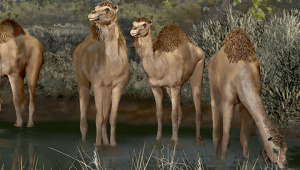
The name is derived from the ancient greek cámēlos, “camel” and óps, “face”. “Camel-face”
Camelops were first described in 1854 by Joesph Leidy. Bones have been found in numerous sites, from Alaska and Cdn Yukon down into Mexico.
Its believed that the family Camelidae, (camels and llamas), originated in north America during the middle Eocene period, at least 44 Mya (1)
Both the camel and horse families originated in North America and migrated into Eurasia via the Bering Strait(2).
During Pleistocene warm periods, a smaller morph of Camelops inhabited Alaska and northern Yukon
Like the mastodon, ground sloth megalonyx, and giant beaver castoroides. These specimens date to around 45-50,000 years ago. After this time, they seem to have disappeared.
There shoulder height is 7 feet, weight around 1800 lbs (at full growth). And, scientists are unsure about the back humps
They were a large herbivore, eating coarse shrubs and plants, such as saltbrush. It is believed they liked small herds similar to modern Asian and African camels. They mostly lived in lush wetland habitats that supported the small herds. Similar to modern camel species. Camelops probably could travel long distances. Whether or not they could survive for long periods without water, is still unknown. This, and there humps could have been an adaptation that occurred later.

Did you know? 1/3rd of the fossils at found at Tule springs, in the upper Las Vegas (Nevada) valley were camelops. They are also common in the Mojave desert sites.

The genus ranged widely
Alaska in the north, to Oregon and California in the west, southernmost Baja California Peninsula and Mexico and Guatemala in the south, and Tennessee in the east. Fossils have even been found in Colorado.
Remains from the Rancho La Brea tar pits revealed that rather than being limited to grazing, this species likely ate mixed species of plants, including coarse shrubs growing in coastal southern California

Extinction:
Biochemical analyses have shown that clovis tools were used in butchering and hunting camels, and probably contributed to there extinction. The result of human population migration and expansion was probably a significant factor in the reduction of there range. The last species of camelops are hypothesized to have disappeared as a result of new cultures of experienced and efficient hunters. As they moved southeastward across the continent 15-10,000 years ago.

Did you know? In the 1850s, Arabian camels were tested eating creosote bush from the US-Mexican border. It has been speculated to be part of camelops’s diet, based on the fact that no local living ungulate eating it. It was readily consumed in the experiment conducted by the United States camel corps. (3)
Though, of the many camelops specimens recovered in North America, only a small number demonstrate modification through human actions
Some specimens have been interpreted as having been killed by humans based on the presence of spirally fractured bone fragments. Like for marrow extraction. Others possible shapes and working edges of bone, that look like they may have been used as chopping tools.
None of the reported camelops sites has been associated with stone tools, however, it would be a big indicator of possible human use (4)
Perhaps there is another explanation. Why they went extinct around 11,700 years ago.
Check out some more fish & wildlife; and, neolithic architecture today!
Cite: 1) “Camelops” (https://web.archive.org/web/20110904045057/http://www.anzaborregopaleo.org/C
AMELOPS.html). Anza-Borrego Desert State Park Paleontology Society. Archived from the
original (http://www.anzaborregopaleo.org/CAMELOPS.html)
2) Hutchinson, Jon (2012-08-14). “Camel Country: Where have all our camelops gone?” (https://w
ww.verdenews.com/news/2012/aug/14/camel-country-where-have-all-our-camelops-gone/).
Verde Independent. Archived (https://web.archive.org/web/20190707182129/https://www.verde
news.com/news/2012/aug/14/camel-country-where-have-all-our-camelops-gone/) from the
original on 2019-07-07.
3) “The US Army’s Camel Corps by C. F. Eckhardt” (http://www.texasescapes.com/CFEckhardt/U
S-Armys-Camel-Corps.htm). Archived (https://web.archive.org/web/20220120030723/http://tex
asescapes.com/CFEckhardt/US-Armys-Camel-Corps.htm)
4) Haynes, Gary; Stanford, Dennis (September 1984). “On the possible utilization of Camelops by
early man in North America” (https://web.archive.org/web/20140309104319/http://www.unr.edu/
cla/anthro/people/faculty/haynes/download%20Haynes+StanfordCamelops.pdf) (PDF).
Quaternary Research. 22 (2): 216–230. Bibcode:1984QuRes..22..216H (https://ui.adsabs.harv
ard.edu/abs/1984QuRes..22..216H). doi:10.1016/0033-5894(84)90041-3 (https://doi.org/10.10
16%2F0033-5894%2884%2990041-3). S2CID 129762421 (https://api.semanticscholar.org/Cor
pusID:129762421). Archived from the original (http://www.unr.edu/cla/anthro/people/faculty/hay
nes/download%20Haynes+StanfordCamelops.pdf) (PDF) on 2014-03-09. Retrieved
2012-10-26.
Bibliography: Beck, Michael W. (10 November 1996). “On Discerning the Cause of Late Pleistocene
Megafaunal Extinctions”. Paleobiology. 22 (1): 91–103. Bibcode:1996Pbio…22…91B (https://u
i.adsabs.harvard.edu/abs/1996Pbio…22…91B). doi:10.1017/s0094837300016043 (https://doi.o
rg/10.1017%2Fs0094837300016043). JSTOR 2401044 (https://www.jstor.org/stable/2401044).
S2CID 85102271 (https://api.semanticscholar.org/CorpusID:85102271).
Scott, J. (2009-02-26). “Camel-butchering in Boulder, 13,000 years ago” (https://web.archive.or
g/web/20100610052715/http://artsandsciences.colorado.edu/magazine/2009/02/camel-butcheri
ng-in-boulder-13000-years-ago/). Colorado Arts and Sciences Magazine. University of
Colorado at Boulder. Archived from the original (http://artsandsciences.colorado.edu/magazin
e/2009/02/camel-butchering-in-boulder-13000-years-ago/)
Murray, Marian (1974). Hunting for Fossils: A Guide to Finding and Collecting Fossils in All 50
States. Collier Books. p. 262. ISBN 9780020935506
Heintzman, Peter D.; Zazula, Grant D.; Cahill, James A.; Reyes, Alberto V.; MacPhee, Ross
D.E.; Shapiro, Beth (2 June 2015). “Genomic Data from Extinct North American Camelops
Revise Camel Evolutionary History”(https://doi.org/10.1093%2Fmolbev%2Fmsv128). Molecular Biology and Evolution. 32 (9): 2433–2440. doi:10.1093/molbev/msv128 (https://doi.or
g/10.1093%2Fmolbev%2Fmsv128). PMID 26037535 (https://pubmed.ncbi.nlm.nih.gov/26037535).
Leave a Reply