<home # start here # guides # builds # services # shop # about # categories>
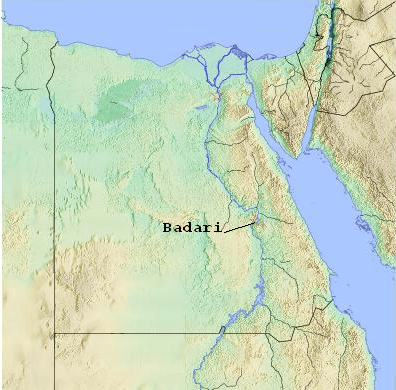
Badari is one of the most important archaeological landscapes for understanding the beginnings of farming, pastoralism, craft production and Egyptian funerary culture. But there is an important distinction at the beginning: “Badari” is both a modern district and the name given to a cultural tradition, while Mostagedda is one of the major archaeological localities within that district. The evidence comes from Badari itself, Mostagedda, Hemamieh, Deir Tasa, Matmar and other sites that spread along the roughly 30–35 km section of Nile Valley. [1][2]
The conventional Badarian date is about 4400–3800 BC, although older chronologies sometimes began it earlier, around 5000 BC. Bayesian radiocarbon work has strengthened the approximately 4400–3800 BC range. [1][3]
What makes Badari particularly interesting for Neolithic Architecture is the contrast: The houses were surprisingly temporary and lightweight, while the graves were carefully constructed, furnished and repeatedly revisited. In other words, these people may have invested more architectural effort in remembering the dead than in building permanent houses. That is an extraordinary clue to how they organized society. [2][3]
Where was it?
The Badari region lies in Middle/Upper Egypt, on the east bank of the Nile, in modern Asyut Governorate. It is not Lower Egypt in the archaeological-geographical sense used for the Nile Delta. It is substantially upriver from Cairo and the Delta, but north of the great southern Upper Egyptian centres such as Naqada and Hierakonpolis. One modern geographical definition places Badari within Middle Egypt, although older Egyptian terminology often treats the whole region south of Cairo as Upper Egypt. [1][4] The Badari archaeological landscape extends for approximately 30–35 km along the east side of the Nile, between the Asyut area in the north and Qau/El-Manieh toward the south. Mostagedda lies about 10 km south of modern Asyut. [2][5]
It was very close to the Nile
The settlements and cemeteries were generally positioned on the low desert immediately bordering the floodplain, beneath the limestone escarpment. They were not oasis settlements hundreds of kilometres from water. They occupied the narrow ecological zone between Nile floodplain, low desert and limestone cliffs and wadis.
The east-bank floodplain in this part of Egypt was relatively narrow, while the limestone desert rose behind it. Small wadis cut the desert into projecting spurs, many of which became locations for Badarian habitation and cemeteries. [2][6]
Imagine: a river valley, with green floodplain below, a strip of dry ground beside it, and limestone desert rising behind.

Badari was not coastal, but it was connected indirectly to both the Red Sea and wider trade networks
Red Sea shells occur in Badarian graves, including species of Ancillaria, Conus, Cypraea, Nerita, Oliva, Strombus and others. Some were probably ornaments rather than food. [6] The Eastern Desert, between the Nile and Red Sea, also supplied: carnelian, jasper, agate, steatite, malachite, hematite, mica, olivine, meta-greywacke, silicified wood and other colourful stones. The famous Wadi Hammamat route connected the Nile with the Red Sea farther south, and Badarian objects include meta-greywacke whose known Egyptian source is that region. [6]
There wasn’t lakes either but the Nile floodplain contained seasonal wet environments, while wadis could carry water during rainfall events
The environmental zone between floodplain and desert would have been much richer than today’s dry landscape. [6][7] Hiding was an important Neolithic lesson. Sometimes the most sophisticated “engineering” is knowing where to put the settlement relative to naturally recurring water.
What was the environment like?
It was drier than the early Holocene Sahara, but not necessarily as uniformly harsh as modern Upper Egypt. The Badarian period falls within the broad transition from the Middle Holocene African Humid Period toward the increasingly dry environments of later prehistoric Egypt. Regional palaeoclimate evidence shows that: around 10,000 years ago, North Africa was substantially wetter;
between roughly 9000–6000 years ago, large areas of the Sahara supported grasslands, lakes and seasonal water;
after about 6000 BC, monsoon rainfall progressively retreated southward;
drying accelerated through the fifth and fourth millennia BC;
major regional hyper-aridification became particularly pronounced around 4200–4000 years ago, although the timing differed geographically. [7][8][9]
So Badarian people were living after the beginning of the drying trend, but before the fully hyper-arid landscapes familiar today.
A simplified environmental timeline is useful:
Approx. time Broad environmental picture
10,000 years ago Early Holocene humid conditions; much of the Sahara considerably greener than today
8,000 years ago African Humid Period; extensive grasslands, wetlands and lakes existed across parts of North Africa
6,000 years ago Increasing drying, but substantial wetlands, grasslands and seasonal water remained in many regions
5,000–4,500 years ago Badarian period; Nile floodplain remained the reliable ecological core while surrounding desert became progressively drier
~4,200 years ago Major aridification event affecting the wider Nile/Sahara system
After ~4,000 years ago Much stronger development of the hyper-arid Sahara familiar today
Pollen records from the Nile Delta show episodes of reduced Nile flow around 6000–5500, 5000 and 4200 years ago, while sedimentary studies indicate increasing Egyptian aridification between roughly 5000 and 4000 years ago. [8][9]
The climate did not suddenly change everywhere at exactly the same date. The African Humid Period ended in a geographically uneven, fluctuating way.
There was probably not forests in the modern temperate sense, but the Nile Valley could support substantial woody vegetation
Palaeoenvironmental reconstruction suggests a mosaic: river, wetlands, grassland, scattered trees and desert. Potential vegetation included riverine and floodplain trees such as: acacia; sycamore/fig; tamarisk; Ziziphus; and other thorn woodland species. One reconstruction of the prehistoric Nile Valley describes riverine thorn woodland on wetter levees and grass-savanna on somewhat higher ground. [10] So if you could stand at Badari 4,500–5,000 years ago, the view would probably not resemble either: a modern tropical rainforest, or an endless modern Sahara. It would have looked more like a green river corridor surrounded by increasingly open savanna and desert-edge country.
Some say the Badarian settlements were fascinating
They were surprisingly ephemeral. Archaeologists found numerous settlement traces along the desert edge, but many consisted of: thin occupation deposits; hearths; ash; post-holes; animal dung; pits; pottery fragments; stone tools; and storage installations. There are very few substantial house foundations. Wengrow and colleagues therefore interpret much of the fifth-millennium Nile Valley habitation evidence as seasonal encampments of mobile herder-fisher-forager communities, rather than densely built permanent villages. [3] UCL’s summary similarly describes Badarian villages as small and probably short-lived, with huts constructed from lightweight materials. [1]
It’s possible they had sunken or subterranean houses
Mostagedda provides an unusually interesting example. At Mostagedda, excavator Guy Brunton recorded four wooden stumps forming part of what he described as some kind of hut or shelter. Three were approximately 40–50 cm high and set about 50 cm apart. Brunton suggested that they might represent part of a sunken hut base with an entrance toward the south. [6] Nothing comparable to the large subterranean architecture of Jericho or Catalhoyuk.
There is timber but it appears scarce and selectively used
Wooden posts occur in Mostagedda occupation contexts, and the possible hut described above contained wooden stumps. [6]
Timber framing. Possible in lightweight shelters, but not securely reconstructed.
Wattle-and-daub. Reed, grass, sticks and other plant materials certainly existed and were used for mats, baskets, rope and funerary structures. A light reed-and-stick shelter is plausible, but a fully reconstructed Badarian wattle-and-daub house would go beyond the evidence. [6]
Did you know? Archaeological humility is when we know lightweight plant architecture existed; but we do not know exactly what every house looked like.
Why is so little architecture preserved?
There are several possibilities.
- The buildings really were temporary. Mobile pastoral communities have little reason to build heavy structures.
- The main settlements may have been on the floodplain. If permanent houses existed closer to the Nile, they could have been destroyed or buried by: Nile alluvium; later agriculture; channel migration; and/or repeated occupation. Several archaeologists have suggested that the visible desert-edge settlements could be the peripheral remains of settlements whose main habitation areas have disappeared beneath the floodplain. This remains a hypothesis, not an established fact. [3]
- Organic architecture disappeared. Reed, grass, hide and lightweight wood disappear much more easily than pottery and stone.
Could a missing Badarian settlement now be buried? Yes
The surviving Badarian sites tend to occur on desert spurs because those places were less vulnerable to later floodplain burial. Researchers have specifically suggested that more permanent habitation could have existed nearer the floodplain and subsequently been covered by Nile sediments or destroyed by agricultural activity. [3][6]
The missing village may be under Nile mud rather than under a sand dune.
Yes. Hearths
Hearths are among the clearest architectural features of Badarian habitation. They occur together with: ash; animal remains; pottery; stone tools; dung; and occupation debris. This fits a settlement system where people repeatedly returned to particular locations rather than maintaining massive permanent houses. [3][6]
Ovens?
There is an intriguing example at Mostagedda. Brunton recorded a dome-shaped oven-like structure made from rough lumps of mud, fire-baked, and set into a hole about 20 cm deep. Unfortunately, its precise function could not be established. [6] So, it had oven like features but is not a known bread oven. There is no convincing evidence for large-scale bakery architecture.
Beds, benches, chairs and furniture?
There is no securely reconstructed Badarian furniture suite. However, people clearly made substantial use of: reed mats; woven textiles; baskets; fibre; hides; wooden sticks; and containers. The dead were often laid on mats, and some graves contained structures made from sticks or plant material. [6][11] So rather than imagining wooden beds and chairs, which decompose. It is safer to imagine a household whose “furniture” could be portable, woven and multifunctional.
Storage was important
At Mostagedda, Brunton described pits lined with matting or basketry, which he interpreted as storage or grain pits. Large pottery vessels also provided storage. [6] But the evidence is complicated because some supposed “granaries” may have been later intrusions.
How important was agriculture?
Older descriptions often portray the Badarians as straightforward early farmers who grew: wheat; barley; flax; lentils and other crops.
Modern reassessment is more cautious. Directly dated emmer wheat and barley from Mostagedda demonstrate that cereals were present. But the archaeological contexts of some grains recovered by Brunton were lost or uncertain. Wengrow and colleagues concluded that the evidence does not justify assuming a strongly agriculture-dependent or fully sedentary society. [3] Their preferred interpretation is low-level cereal cultivation on the floodplain combined with seasonal herding, fishing and foraging. [3]
There is secure evidence for Emmer wheat (Triticum dicoccum), and Barley (Hordeum)
Two directly dated grain samples from Mostagedda were particularly important in the modern reassessment. But their precise original archaeological contexts are unfortunately no longer secure. [3][12]
So: Wheat and barley, yes. Huge agricultural fields, no evidence.
Lentils and peas are much less secure
Later Egyptian prehistoric agriculture clearly included a wider range of crops, but the Badarian plant record is extremely poor because early excavations did not systematically recover botanical remains.
Vetch (Vicia) was identified at Hemamieh and interpreted as a weed associated with wheat/barley cultivation. [6] It is therefore safer not to put lentils and peas into the core Badarian subsistence list unless specifically labelled as uncertain or later evidence.
Wild grasses were certainly important
Sickle blades and grinding stones occur in the Badarian assemblage, and wild grasses and cereals could have been collected and processed even when domesticated agriculture was limited. [3][6] This creates an interesting possibility that farming and foraging were not necessarily separate lifestyles. A family could: herd goats; fish the Nile; gather wild grasses; harvest cultivated wheat; hunt; collect fruits; and move animals to pasture; all within the same annual cycle.
Animals: livestock or wild game?
The answer is both, with increasing importance of domestic animals. Badarian evidence includes cattle; sheep; goats; dogs; gazelle; hippopotamus; birds; fish; turtles; crocodile; and other wild animals. But the archaeological record is frustratingly incomplete because systematic faunal sampling was not performed during most of the early excavations. [3][6] The overall economic picture is therefore best described as a mixed pastoral-fishing-hunting-gathering system with some crop cultivation.
Pigs are interesting
Pig is not prominent in the earliest Badarian evidence and appears much more clearly in later Predynastic communities. The Badarian economy appears to have emphasized cattle, sheep and goats rather than pigs. [13] This is one of the differences between the Badarian communities and some contemporary northern Egyptian communities.
Cattle were present and important, but we should avoid imagining a fully developed “cattle cult” like some later or western-desert traditions. There are a few cattle burials, but they represent only a tiny fraction of the hundreds of human graves. [6] This is significant because it suggests cattle were valuable without necessarily being the central religious symbol of Badarian society.
Fish were definitely exploited
Badarian sites produced remains of Nile perch (Lates), catfish (Synodontis) and other fish. Fishing hooks were also made from shell and ivory. [6] The Nile was immediately available and would have supplied a dependable seasonal source of protein.
Turtles, crocodiles and hippos all appear in the archaeological record
Turtle. Turtle plates were found at Mostagedda;
Crocodile. A crocodile plate was recovered from Badari Grave 5115; and
Hippopotamus. Hippo ivory and tusks occur repeatedly at Mostagedda and Badari. [6]
The hippopotamus is especially important because it connects the archaeological objects to the larger Nile wetland ecosystem. They weren’t living beside a little desert stream. They were living within a landscape capable of supporting some very large aquatic animals.
Snails and shellfish
Freshwater molluscs occur, while many marine shells came from the Red Sea. The marine shells were often used as ornaments rather than necessarily being food. [6]
There is no strong archaeological evidence for mushroom/fungal exploitation at Badari or Mostagedda.
The best reconstruction is a mixed diet
Plants: wheat, barley, wild grasses, gathered plants and possibly fruits and other wild resources.
Animals: sheep, goats, cattle, fish, birds, gazelle and other wild animals
Aquatic: Nile perch, catfish, turtles and possibly other Nile fauna
The exact proportions remain uncertain. And, its misleading to call them either: “farmers” or “pastoralists.” They appear to have been flexible Nile Valley herder, fisher, forager and farmers.
Tools
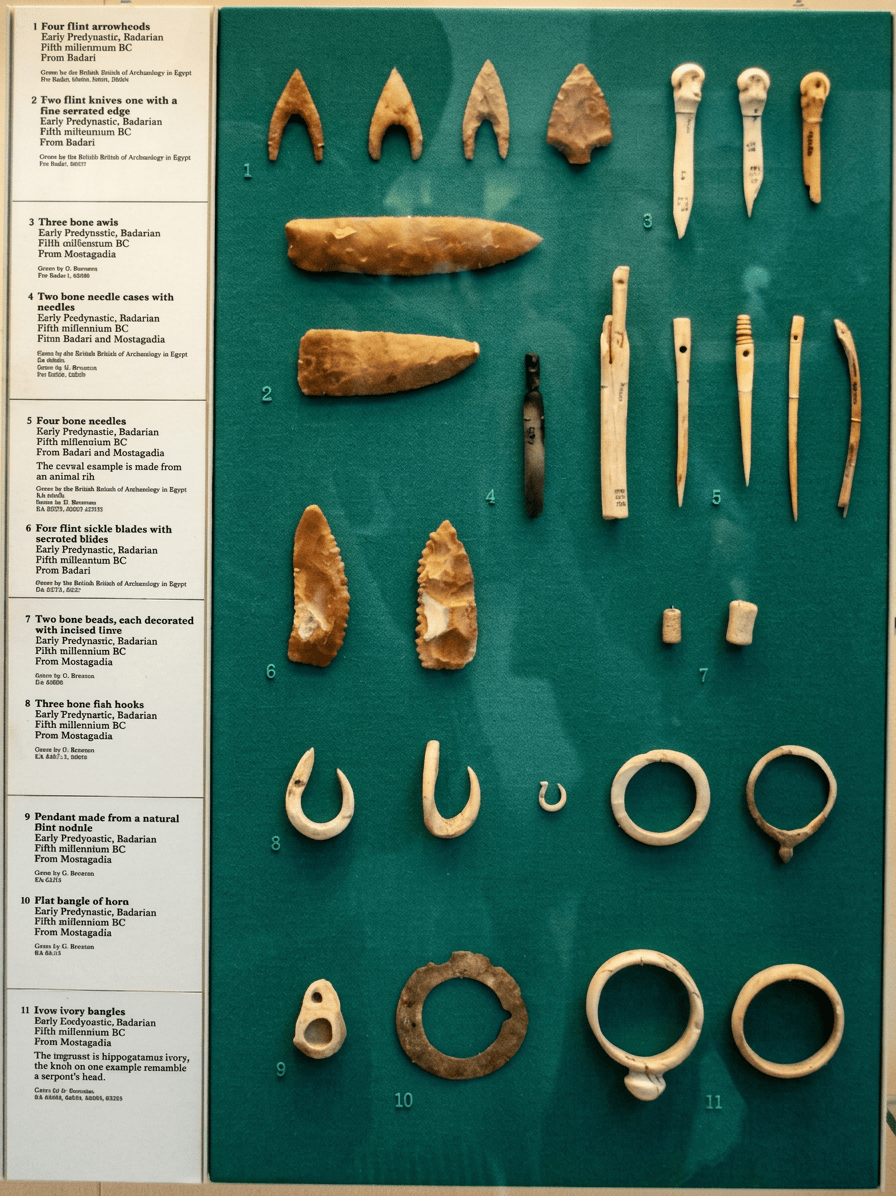
Badarian stone technology was sophisticated but not industrial. Tools included: flint blades; flakes; scrapers; bifaces; arrowheads; sickle elements; axes; grinding stones; palettes; bone tools; ivory tools; fish hooks; awls; and needles.
Sickle elements suggest harvesting or processing grasses/cereals, while axes indicate working wood or tough plant materials. [6]
A small number of tools could support: hunting, fishing, plant processing, woodworking, butchery and textile/fibre production. That fits a mobile or semi-mobile society extremely well.
Pottery: one of Badari’s great achievements
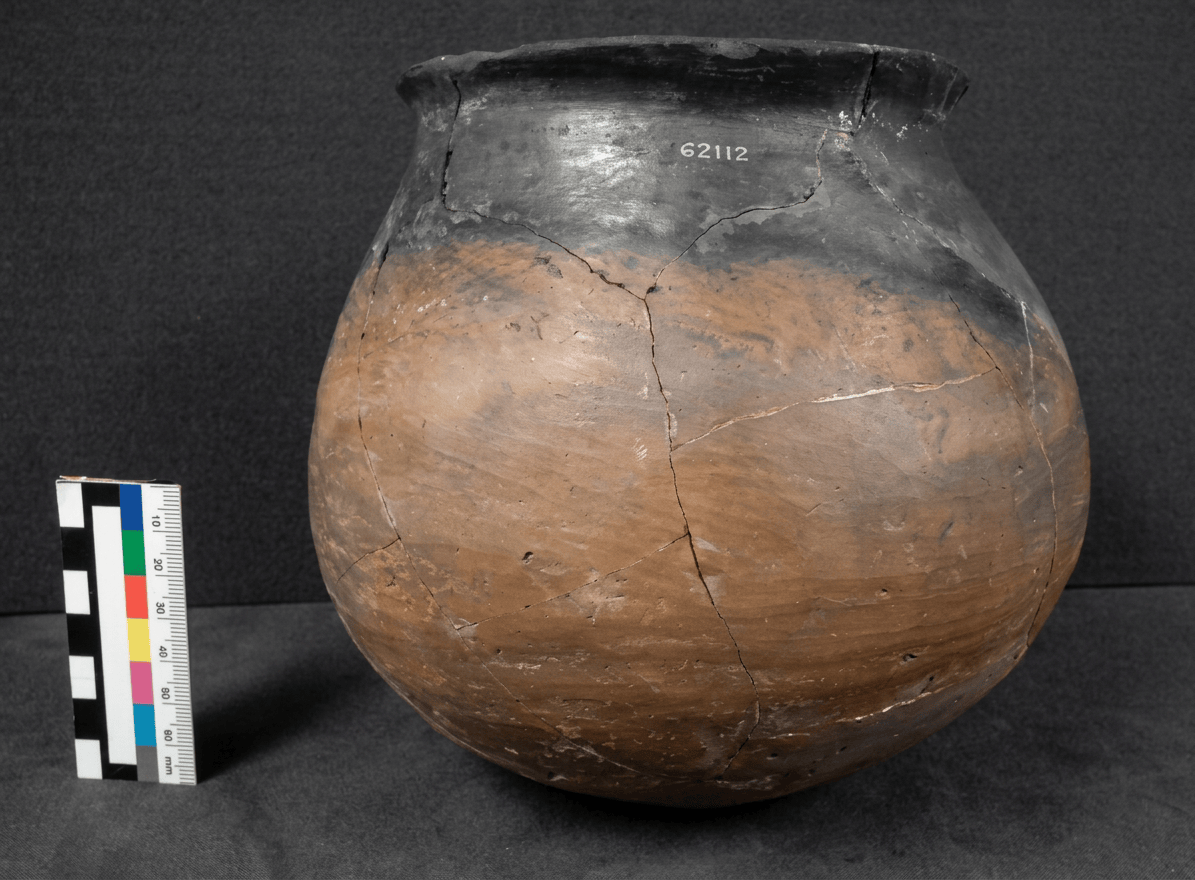
Badarian pottery is among the most distinctive prehistoric ceramics in Egypt. It includes: thin-walled vessels; red and brown pottery; highly polished surfaces; black-topped vessels; ripple decoration; combed surfaces; incised designs; bowls; dishes; and storage vessels.
Many vessels were made by hand, probably using coiling and subsequent smoothing/combing. Some were repaired after breaking, suggesting that pottery was valuable enough to repair rather than simply discard. [6] There is no evidence for large centralized pottery factories. This is an excellent example of Neolithic craft knowledge being transmitted without industrial infrastructure.
Badarian communities produced some of the earliest glazed objects known in Egypt, particularly beads
It is remarkable because they were experimenting with materials, heat and surface chemistry thousands of years before the spectacular glazed industries of later Egypt. [1][6]
Copper beads and a copper pin are known from Badarian contexts, and the British Museum holds copper beads from Mostagedda [14]
The copper is particularly interesting because it demonstrates that Badarian communities were not exclusively dependent upon stone. Some of the early copper objects may have been made from native copper rather than requiring sophisticated smelting technology. [6]
Gold was available in the Eastern Desert, and later Egyptian society exploited it extensively
But I would not describe Badari as a gold-working centre. There is a much stronger archaeological case for their access to: copper; carnelian; jasper; agate; hematite; serpentine; steatite; meta-greywacke; and Red Sea shells. Some of these materials travelled considerable distances. [6]
The beautiful stone beads
Some Badarian graves contained beads of: carnelian; green jasper; serpentine; and limestone and other stones. Several of these materials probably came from the Eastern Desert/Red Sea Hills, demonstrating considerable geographic knowledge and exchange. [6] This is important architecturally because it tells us something about the people who built even the simplest shelters. Simple houses do not mean simple societies. A community can have lightweight houses and sophisticated long-distance exchange networks at the same time.
Another strong area of evidence: Reed, fibre, textiles and baskets
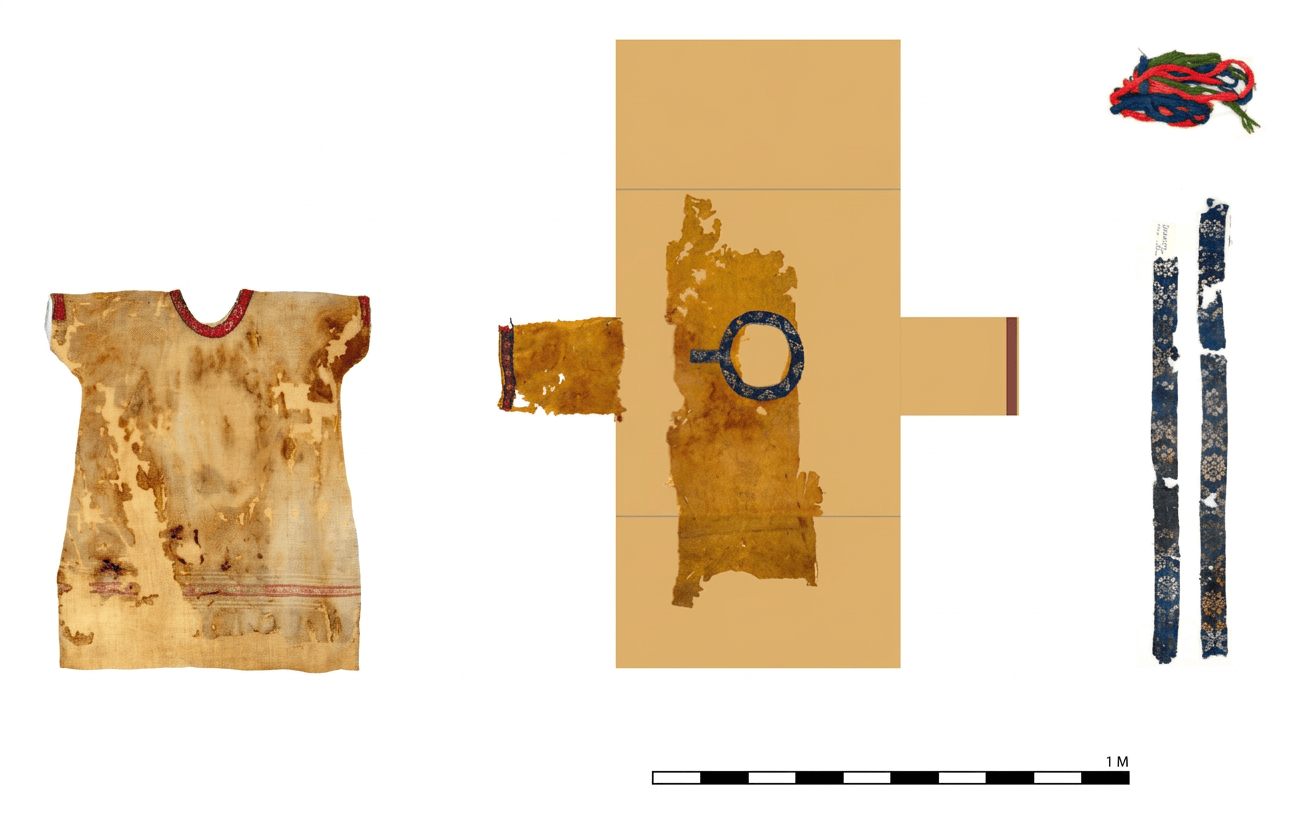
Badarian graves preserve: linen; reed matting; grass matting; basketry; cordage; woven materials; plant fibres; and animal skins. Reeds, grasses and sticks were used to make mats, ropes, basket-like containers and grave furnishings. Flax was used for linen textiles. [6][11] Hugely important for architecture. A house built from reeds may leave almost nothing archaeologically. A stone axe survives. A reed wall disappears. So the surviving archaeology can create a false impression that stone was more important than fibre architecture. It may simply be the opposite.
The “portable house” idea
The Badarian evidence is compatible with a fascinating architectural concept: A house did not necessarily have to be permanent. A family could carry: mats; ropes; baskets; skins; textiles; tools; and cooking vessels. While only leaving behind a few postholes, hearths and pits. That is architecture designed around mobility. Badari therefore coule be presented as an example of architecture as a kit of parts rather than architecture as a permanent building.
Burials: where Badari becomes extraordinary
The cemeteries are arguably more important than the houses. Around 600 Badarian graves were excavated and recorded in the broader archaeological investigations. [1][2] Most graves were relatively simple pits, often oval, with bodies placed in a contracted position, frequently on the left side and commonly oriented toward the west. Reed matting and other organic materials were used around the body. [2][6]
Grave goods could include: pottery; stone tools; palettes; beads; ivory; shells; copper; personal ornaments; animal representations; and textiles. This is an enormous change from simply leaving the dead in the landscape.
The funerary technology is significant. Because the Badarian cemetery represents one of the earliest large-scale expressions of a distinctly Egyptian relationship between body, material possessions, landscape and ancestors
The cemeteries were repeatedly used places. Wengrow and colleagues argue that these burial grounds became a way of establishing durable connections to particular places even while habitation remained relatively mobile. [3] That gives us an intriguing equation: Temporary house and Permanent memory. The architecture of the settlement may disappear. The cemetery anchors the community to the landscape.
Early experiments with mummification
This is perhaps the most extraordinary Badarian discovery. Modern chemical analysis of funerary textiles from Mostagedda found evidence of deliberately applied substances including: pine/conifer resin; aromatic plant extracts; plant gum/sugar; natural petroleum-derived material; and plant oil and/or animal fat.
The materials were found in directly dated Badarian funerary wrappings [11]
The researchers concluded that these treatments had antibacterial and preservative properties and represented very early experimentation with artificial preservation of the body, more than a millennium before the previously recognized evidence for sophisticated Egyptian mummification. [11] This does not mean that a fully developed Pharaonic mummification system existed at Badari. It means something arguably more interesting: People were already experimenting with chemistry to control what happened to a human body after death. An extraordinary technological development.
Why the textiles matter so much
The Badarian textile evidence allows archaeologists to reconstruct technology that would otherwise have vanished. They can study: plant, fibre, spinning, weaving, wrapping, chemical treatment and burial. Modern microscopy, radiocarbon dating and GC-MS chemical analysis have transformed apparently ordinary fragments of ancient cloth into evidence for a sophisticated technological tradition. [11] This is a perfect example of why preserving archaeological collections matters. The excavation happened nearly a century ago. The most important discovery was made decades later in a museum laboratory.
No large ceremonial architecture is securely known from the Badarian settlements
There are no Badarian equivalents of: Göbekli Tepe’s monumental enclosures; later Egyptian temples; Stonehenge; or large communal halls. Instead, ritual investment appears to be concentrated in: cemeteries, graves, grave goods, body treatment, animal burials and feasting/social gatherings. The cemetery itself was therefore an important communal institution even without a monumental building. [3][6]
Animal burials
A very small number of animals were treated almost like human dead. The broader Badarian record includes: cattle; sheep/goats; and dog burials. But these are rare compared with human graves. [6] This is important because it demonstrates that animals could have social and symbolic value, but we should not automatically reconstruct a full-fledged cattle religion.
One of the delightful Badarian finds is evidence for model boats
Several clay boat models were recovered from Badari/Mostagedda contexts. [6] This makes perfect sense geographically. The Nile was not simply something to drink from. It was food source, water source, transportation corridor, communication network and cultural highway. A boat could potentially move people and goods far beyond the immediate Badari district.
Something everyone should know about Badari
Badari shows that the origins of Egyptian civilization were not simply the invention of farming villages with permanent mudbrick houses. The evidence instead points toward communities combining: herding, fishing, hunting, gathering, small-scale cultivation, craft production, exchange and highly developed funerary practices. Their settlements could be ephemeral while their cultural connections were remarkably durable. [3] One of the most important corrections to the old picture of “the first farmers.”
Was Badari in extreme environments?
Compared with today’s world, the surrounding desert was still harsh. But compared with today’s Upper Egyptian desert, the fifth millennium BC landscape was probably considerably more biologically productive. The crucial ecological advantage was the Nile. Even as surrounding rainfall declined, the river continued to provide: water; fish; floodplain vegetation; fertile silt; grazing; and transportation. This is why the Nile became such a powerful ecological refuge as surrounding regions became increasingly dry. [7][8]
Did climate change cause the Badarian people to abandon the site?
I would not describe Badari as a single settlement that was suddenly abandoned because of climate change. The archaeological situation is more complicated. The Badarian cultural tradition gradually gives way to Naqada I around the late fourth millennium BC, with current chronologies placing the Badarian roughly at 4400–3800 BC. [3][4] At the same time the Sahara was drying; desert pastoralists were increasingly drawn toward reliable Nile resources; settlement patterns were changing; agriculture became more important; and, larger and more permanent settlements developed later. So climate change was certainly part of the wider environmental story, but there is no single “Badari abandonment event” comparable to the abandonment of a desert oasis after its water source failed.
Climate change probably made the Nile Valley more important
This is one of the most interesting large-scale processes of the period. As rainfall retreated southward across the Sahara, people could no longer depend as easily on seasonal lakes; grasslands; desert waterholes; and rainfall-fed pastures. The Nile remained dependable. This helped increase the relative importance of the river corridor. But be cautious saying “climate change caused Egyptian civilization.” The archaeological record suggests a more complicated interaction between environment, mobility, pastoralism, agriculture, exchange, population and social organization. [3][8]
The Badarian culture was first recognized during Guy Brunton’s excavations in 1923, when unusual handmade pottery with distinctive rippled/combed surfaces was found at Qau el-Kebir [1]
Brunton subsequently worked with Gertrude Caton-Thompson, whose stratigraphic excavation at Hemamieh was especially important. The early campaigns took place between: 1922–23; 1923–24; 1925; and later work continued in the region. [15]
Gertrude Caton-Thompson work at Hemamieh was pioneering
She excavated the settlement in measured layers rather than simply collecting attractive objects from graves. This allowed her to investigate the relationship between Badarian and later Predynastic occupation. And, establish that Badarian material occurred in the lower archaeological levels. [2] That was a major methodological step. The site became important not merely because of spectacular pottery, but because archaeologists could begin asking: Which things came first? Which came later? And, What actually belongs together?
Who has studied Badari since then?
Important researchers and research traditions include numerous specialists in Egyptian archaeology, archaeobotany, zooarchaeology, textiles, radiocarbon dating and materials science. Diane Holmes and RF Friedman conducted archaeological survey and test excavations in the Badari region in the late twentieth century, while more recent work has re-examined the old museum collections using radiocarbon and scientific analytical techniques. [3][11][15]
Badari demonstrates why archaeology is not finished when the excavation ends
The original excavators could see: pottery, bones, textiles and graves. Modern researchers can additionally see radiocarbon dates, plant species, chemical preservatives, trade networks, fibre technology, molecular residues and changing climate. That archaeological site is effectively being excavated a second time inside museum collections.
Badari gives us a very different definition of architecture from the one we normally use
Architecture does not have to mean: walls, roof and permanent foundation. At Badari, it could mean: a reed mat, a woven basket, four wooden posts, a hearth, a storage pit, a shelter and a carefully prepared grave. The technical system was distributed between people, tools, plants, animals and landscape.
Badarian “architecture for survival”
Imagine a Badarian household. They wake beside the Nile. They collect water. Someone tends goats. Someone processes grain or wild grasses. Someone fishes. Someone repairs a basket. Someone sharpens a flint blade. A fire burns in a shallow hearth. A reed mat serves as floor, bed, container or burial furnishing. A light shelter protects the family but can be abandoned. The Nile carries boats and information. The desert supplies stone, minerals and grazing. And, on a nearby rise is a cemetery where generations of people have carefully buried their dead. That is not a primitive version of a later Egyptian city. It is a different architectural system.
Why Badari matters to Neolithic Architecture?
Badari is especially useful because it challenges the assumption: “More permanent architecture = more advanced society.” The Badarian record says something different. A community can have: sophisticated ceramics; textile production; metallurgy; long-distance exchange; animal management; fishing; agriculture; specialized stone tools; and chemical treatment of human remains. While leaving behind almost no permanent houses. The missing ingredient is not technological ability. It may simply have been mobility. And, that is a powerful lesson for modern architecture: The simplest building is not necessarily the simplest technology. Sometimes the technology is in the system rather than the wall.
References: [1] UCL Petrie Museum, The Badarian Civilisation — chronology, discovery, settlement character and distribution.
[2] UCL Petrie Museum, The Predynastic village near Hemamieh — excavation history, settlement deposits and hut/shelter evidence.
[3] Wengrow, D., Dee, M., Foster, S., Stevenson, A. & Bronk Ramsey, C. (2014), “Cultural Convergence in the Neolithic of the Nile Valley: A Prehistoric Perspective on Egypt’s Place in Africa,” Antiquity. Particularly important for the revised chronology, mobility, agriculture and settlement interpretation.
[4] Dee, M. et al. (2013), “An absolute chronology for early Egypt using radiocarbon dating and Bayesian statistical modelling,” Proceedings of the Royal Society A. The revised absolute chronology places the Badarian broadly around 4400–3800 BC.
[5] Brunton, G. (1937), Mostagedda and the Tasian Culture, British Museum Expedition, 1928–1929. The principal excavation publication for Mostagedda. The archaeological location and excavation history are summarized by UCL and other catalogues.
[6] D. L. Holmes / R. F. Friedman and subsequent synthesis of the Badari evidence, including the detailed Badarian case study: settlement architecture, tools, plants, animals, raw materials, storage, boats and textiles.
[7] Nicoll, K. (2004), “Recent environmental change and prehistoric human activity in Egypt and Northern Sudan,” Quaternary Science Reviews. The wider Holocene environmental context.
[8] Pennington, B. T. et al. (2019), “Aridification of the Egyptian Sahara 5000–4000 cal BP…” Quaternary International. Important evidence for increasing aridity toward the end of the African Humid Period.
[9] Bernhardt, C. E., Horton, B. P. & Stanley, J.-D. (2012), “Nile Delta vegetation response to Holocene climate variability,” Geology. Provides a long pollen record showing changes in Nile flow and regional aridity.
[10] Oxford Handbook of Egyptology, environmental reconstruction of the prehistoric Nile Valley, including riverine thorn woodland and grass-savanna.
[11] Jones, J., Higham, T. F. G., Oldfield, R., O’Connor, T. P. & Buckley, S. A. (2014), “Evidence for Prehistoric Origins of Egyptian Mummification in Late Neolithic Burials,” PLOS ONE 9(8):e103608. The key scientific study of the Mostagedda funerary textiles and early embalming chemistry.
[12] IntChron / Oxford radiocarbon database, Mostagedda entries: directly dated emmer and barley samples from the Badarian context.
[13] Hendrickx, S. et al. / zooarchaeological reassessments of the Badarian and contemporary Egyptian sites, including the distinction between early Badarian livestock economies and later Predynastic animal assemblages.
[14] British Museum, Badarian copper beads from Mostagedda Grave 596, museum no. EA62158.
[15] UCL Petrie Museum, Badari excavation background, including the Brunton/Caton-Thompson campaigns and later Holmes/Friedman investigations.
Leave a Reply