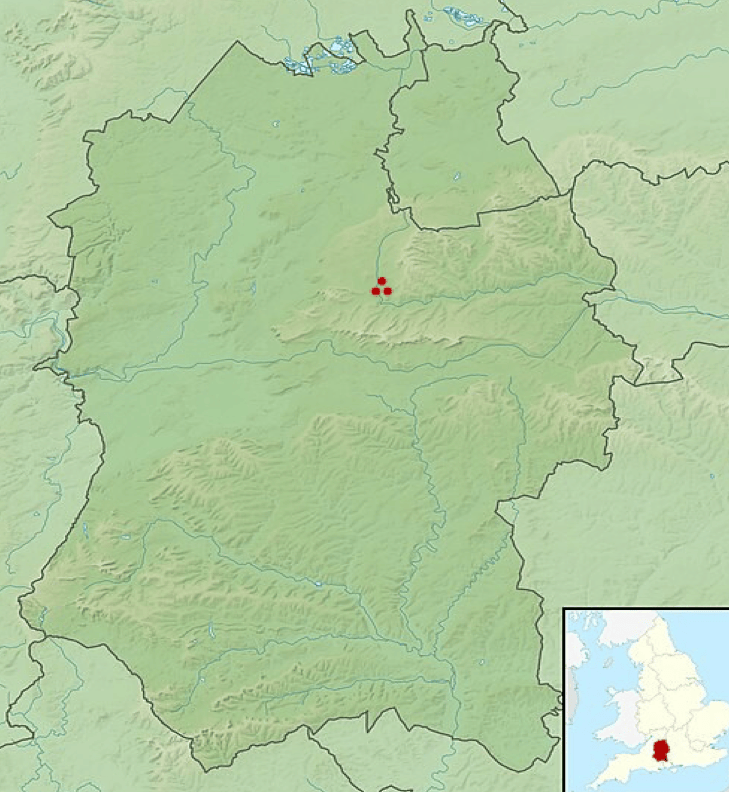
Avebury is a neolithic henge monument containing three stone circles, around the village of Avebury in Wiltshire, in SW England. It is one of the largest and most important neolithic stone circles in Europe

A massive henge monument, and stone circle complex built around 3000–2400 BC (1), during the neolithic period exists. It consists of:
-a huge circular earthwork ditch, and bank, the “henge”, encloses the stone circle. It is not perfectly circular and measures 380 yards in diameter (2); and, over 1000 m in circumference; (3)
-a large outer stone circle, the largest in Britain, about 330 meters / 1,080 feet circumference; (4)
-two smaller inner stone circles; and,
-ancient ceremonial avenues (West Kennet Avenue) linking Avebury to nearby monuments. And, there are traces of a second, the Beckhampton Avenue, heading out from the western entrance.
It is part of the UNESCO World Heritage Site that also includes Stonehenge, about 25 km (15 miles) to the south
Silbury Hill is also nearby
A massive neolithic man-made mound.

The exact purpose of Avebury is still debated, but likely included: ceremonial and ritual activity; seasonal or astronomical alignments; burial and ancestor veneration; social gatherings. Many have postulated about its use (5)
It may have served as a spiritual or cosmological center, symbolizing the connection between land, sky, and people.
It is part of a larger sacred neolithic landscape, including: Silbury Hill, West Kennet Long Barrow & the Sanctuary. Preceded the construction of Stonehenge and had a longer period of use.
Avebury is open to the public and allows walking among the stones. Check it out with some more neolithic architecture today.

Cite: 1) Burl, Aubrey (2002). Prehistoric Avebury (2nd ed.). New Haven and London: Yale University Press Pg. 154
2) Malone, Caroline (2011). Neolithic Britain and Ireland. Stroud, Gloucestershire: The History Press. Pg. 172. ISBN 9780752414423.
3) Burl 2002. Pg. 197-199
4) Darvill, Timothy (1996). Prehistoric Britain from the air: a study of space, time and society.
Cambridge University Press. p. 185. ISBN 978-0-521-55132-8
5) Burl, Aubrey (1979). Prehistoric Avebury (https://archive.org/details/prehistoricavebu00burl). New Haven and London: Yale University Press. ISBN 0-300-02368-5 Pg. 27
Bibliography: Historic England. “Avebury Henge (220746)” (https://www.heritagegateway.org.uk/Gateway/Re
sults_Single.aspx?uid=220746&resourceID=19191). Research records (formerly PastScape).
Retrieved 27 February 2008
Smith, I. (1965). Windmill Hill and Avebury: Excavations by Alexander Keiller 1925–1939. Oxford: Clarendon Press
Leave a Reply