<home # start here # guides # builds # services # shop # about # categories>

For more than a century, archaeologists believed that agriculture came first, villages developed second, and large ceremonial architecture emerged only after societies became settled and prosperous. The discovery of Göbekli Tepe challenged that sequence.
Dating to approximately 9600–8200 BCE, Göbekli Tepe is one of the oldest known monumental building complexes ever discovered. Located in southeastern Turkey, the site consists of massive stone enclosures, carved pillars, symbolic imagery, and evidence of large-scale communal activity. Remarkably, it was built thousands of years before the invention of pottery and before agriculture became fully established across much of the region.
This has led to one of archaeology’s most important questions: Did ritual and shared belief come before farming?
And if so: Could common spiritual, social, and cultural systems have helped create the foundations of civilization itself?
The Traditional Theory: Farming Created Civilization
For much of the twentieth century, archaeologists followed a relatively simple model: Humans learned agriculture;
Food surpluses developed;
Permanent settlements emerged;
Social classes appeared; and,
Temples and monuments were built.
This model suggested that organized religion was largely a product of settled agricultural life.
In this view, people first solved practical survival problems and only later invested resources into symbolic architecture and ceremonial spaces. Göbekli Tepe forced researchers to reconsider this sequence.

Discovery of Göbekli Tepe
Although the hill was known locally for decades, its significance was recognized in the 1990s through the work of Klaus Schmidt.
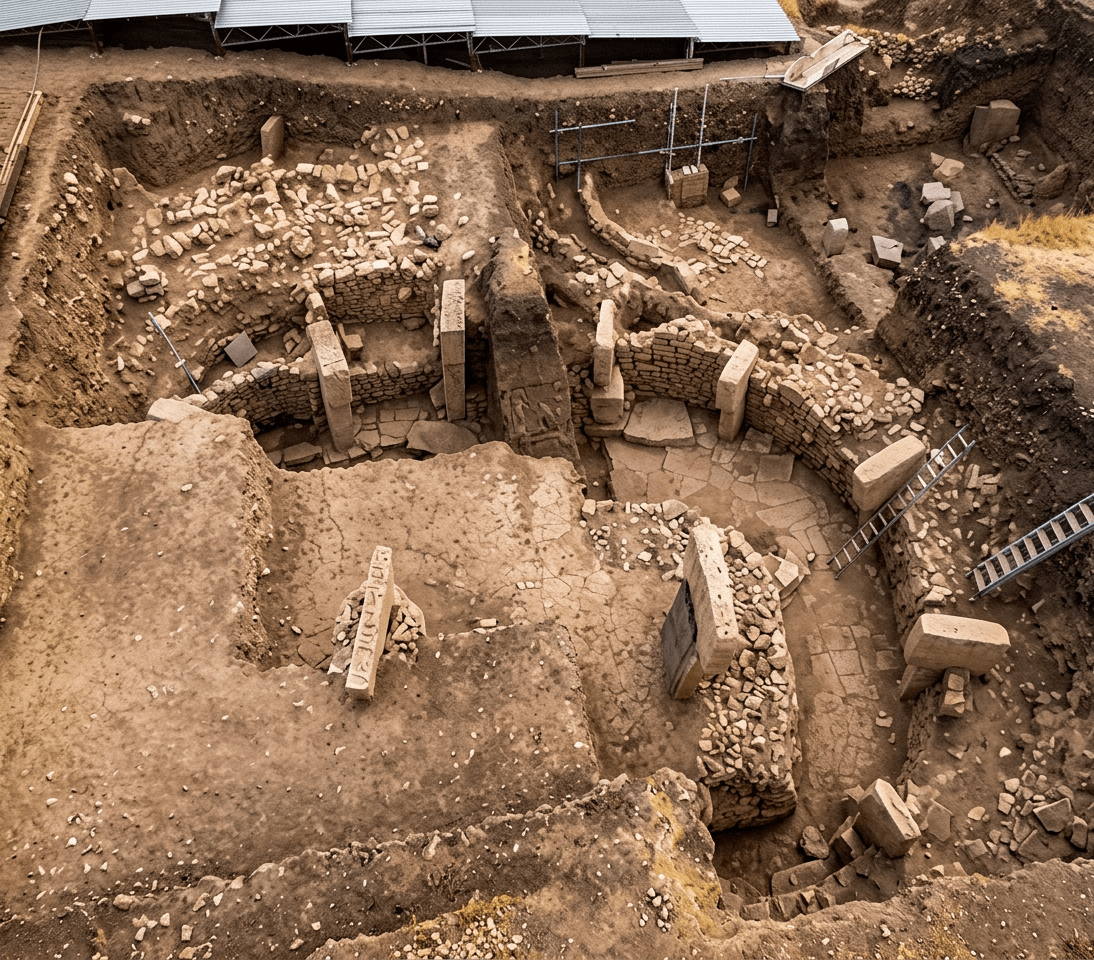
Excavations revealed: circular stone enclosures, t-shaped limestone pillars, pillars weighing up to 20 tons, sophisticated stone carving, animal reliefs and symbolic imagery, evidence of repeated construction episodes and more.
The scale of labor required was extraordinary. Groups lacking metal tools, wheels, draft animals, or advanced farming systems managed to quarry, transport, shape, and erect some of the largest stone monuments of the prehistoric world.
A Monument Built by Hunter-Gatherers?
One of the most surprising aspects of Göbekli Tepe is that it appears to have been constructed by communities still heavily dependent on hunting and gathering.
Archaeological evidence suggests: gazelle hunting was extensive, wild cereals were collected, domesticated animals were largely absent during the earliest phases, and fully developed agriculture may not yet have existed. This means monumental architecture may have emerged before the agricultural revolution was complete. The builders were not necessarily primitive wanderers. They appear to have been highly organized hunter-gatherers capable of coordinating labor, planning construction projects, and maintaining long-distance social networks.

What Was Göbekli Tepe Used For?
No definitive answer exists. Researchers have proposed several possibilities. (ritual center, gathering place, and knowledge center)
Ritual Center: The most widely accepted interpretation is that Göbekli Tepe functioned as a ceremonial or ritual complex. There is supporting evidence of monumental architecture, lack of ordinary domestic structures in early levels, symbolic carvings, deliberate enclosure design and repeated rebuilding of sacred spaces. The structures appear different from everyday housing. Instead, they resemble spaces intended for gatherings, ceremonies, storytelling, teaching, or communal identity.
Gathering Place. Another possibility is that the site served as a regional meeting center. Groups from across northern Mesopotamia may have gathered seasonally to exchange information, arrange marriages, conduct rituals, share technologies, coordinate hunting activities and reinforce social relationships. In this model, ritual and social networking worked together. The monument itself became a physical expression of cooperation.
Knowledge Center. Some archaeologists suggest the site may have served as a place for preserving cultural memory. The carved animals and symbols could have represented clan identities, mythological stories, seasonal knowledge, spiritual beliefs and ecological observations. If true, Göbekli Tepe may have functioned as one of humanity’s earliest educational institutions.
The “Religion Before Agriculture” Hypothesis
Klaus Schmidt proposed a revolutionary idea. Rather than agriculture creating religion, religion may have encouraged agriculture. His argument worked like this large ritual gatherings attracted many people, feeding these gatherings required enormous quantities of food, wild resources became insufficient, communities began cultivating plants more intensively and agriculture developed as a response.
Under this interpretation, temples came before farms. Shared belief created social organization, and social organization encouraged food production. This reversed the traditional story of civilization.
Did Shared Belief Systems Create Civilization?
The answer depends on how civilization is defined. If civilization means: large populations, permanent settlements, complex social organization and cooperation among unrelated groups. Then shared belief systems may have played a critical role. Human beings can cooperate on remarkable scales when united by common ideas.
Shared beliefs create trust, identity, purpose, social rules and group cohesion. At Göbekli Tepe, hundreds of people may have worked together despite not belonging to a single family or village. The monuments themselves may have helped create social bonds. In other words, people did not simply build the site. The site may also have helped build the people.

Architecture as Social Technology
One of the most important lessons from Göbekli Tepe is that architecture can function as a form of social technology. Buildings are not only shelters. They can also: organize communities, create shared experiences, reinforce cultural values, encourage cooperation and establish collective identity. The monumental enclosures at Göbekli Tepe transformed abstract beliefs into physical reality. When people gathered inside these spaces, they participated in a common cultural world. This may have been one of the earliest examples of architecture being used to unite large groups of people.
The Animal Imagery
The site’s famous carvings include foxes, snakes, wild boars, vultures, aurochs, gazelles, birds and predators. These animals likely carried symbolic meaning.
Possible interpretations include spiritual guardians, clan symbols, mythological figures, hunting traditions and cosmological beliefs Although no consensus exists, the carvings demonstrate a highly developed symbolic culture.
The End of Göbekli Tepe
Around 8200 BCE, many of the monumental enclosures were intentionally buried. This was not a natural process. Large amounts of fill material were deliberately placed inside the structures. Why this occurred remains uncertain. Possible explanations include religious transformation, cultural change, shifting settlement patterns, emergence of nearby farming communities and ritual closure of sacred spaces. Ironically, this burial preserved the site for thousands of years.
Criticisms and Alternative Views
Not all archaeologists agree that ritual came before agriculture. Some researchers argue early cultivation may have already been underway, nearby settlements may have supported construction and the distinction between hunter-gatherers and farmers may be less clear than originally believed. Others caution against viewing religion as the sole driver of civilization.
Important factors also include climate change, population growth, trade networks, resource management and technological innovation. Most scholars today view civilization as the product of many interacting forces rather than a single cause.
What Göbekli Tepe Means for Neolithic Architecture
For students of Neolithic architecture, Göbekli Tepe demonstrates several remarkable principles (monumental construction predated cities, cooperation came before states, architecture creates social identity, symbolism matters and shared purpose can organize large groups)
Monumental Construction Predated Cities. Large-scale building projects existed thousands of years before urban civilization.
Cooperation Came Before States. Complex construction can occur without kings, armies, or bureaucracies.
Architecture Creates Social Identity. Buildings help communities understand who they are.
Symbolism Matters. The earliest architecture often served cultural and spiritual purposes alongside practical ones.
Shared Purpose Can Organize Large Groups. Common goals may have been as important as economics in the rise of permanent societies.
Between approximately 9600 and 8200 BCE, the builders of Göbekli Tepe created one of humanity’s earliest monumental architectural landscapes. Whether it functioned as a temple, gathering place, educational center, or all three, the site demonstrates that organized cooperation existed long before cities and empires.

Did rituals occur before farming?
The evidence suggests that ceremonial activity played a major role during the earliest phases of the site, although agriculture was likely developing in parallel across the region.
Did shared belief systems create civilization?
Göbekli Tepe suggests that they may have helped. Shared ideas, symbols, stories, and rituals appear capable of bringing people together, organizing labor, and encouraging cooperation on a scale previously thought impossible for prehistoric communities.
The site reminds us that civilization is not built solely from food, tools, and technology. It is also built from meaning. Long before written language, governments, or cities, people gathered around common beliefs and transformed stone into architecture—creating structures that still challenge our understanding of how human society began.

References: Schmidt, Klaus. 2010. “Göbekli Tepe – the Stone Age Sanctuaries: New Results of Ongoing Excavations with a Special Focus on Sculptures and High Reliefs.” Documenta Praehistorica 37: 239–256.
Watkins, Trevor. 2010. “New Light on the Neolithic Revolution in Southwest Asia.” Antiquity 84 (325): 621–634.
Cauvin, Jacques. 2000. The Birth of the Gods and the Origins of Agriculture. Cambridge: Cambridge University Press.
Graeber, David, and David Wengrow. 2021. The Dawn of Everything. New York: Farrar, Straus and Giroux.
Mithen, Steven. 2003. After the Ice: A Global Human History, 20,000–5,000 BC. Cambridge, MA: Harvard University Press.
Leave a Reply