<home # start here # guides # builds # services # shop # about # categories>

For much of the twentieth century, the story of human civilization was often presented as a straightforward progression: hunter-gatherers settled down, agriculture emerged, villages grew into towns, and towns eventually became cities. In this narrative, each step represented an advance toward increasing complexity and permanence.
Recent archaeological research, however, paints a more complicated picture. Many early settlements appear less like inevitable stages of progress and more like social experiments—attempts to organize human life in new ways that sometimes succeeded, sometimes failed, and often changed dramatically over time (Graeber & Wengrow, 2021).

Sites such as Jericho, Çatalhöyük, and Ain Ghazal reveal that the transition to settled life was not always stable, permanent, or predictable. Instead, many communities faced recurring challenges involving resources, social organization, climate, disease, and population growth. The Neolithic world may have been characterized not by linear progress, but by continuous adaptation and experimentation.

The Traditional Narrative of Progress
The classic model of the Neolithic Revolution, strongly associated with archaeologist V. Gordon Childe, emphasized agriculture as a transformative breakthrough that led to permanent settlements, surplus production, specialization, and eventually civilization (Childe, 1936). This framework remains influential because agriculture did enable significant demographic and technological changes. However, archaeological evidence increasingly suggests that the process was neither uniform nor irreversible. Communities often relocated settlements, abandoned villages, changed subsistence strategies, shifted social organization and experimented with different architectural forms. Rather than a straight line, the Neolithic transition appears more like a network of branching pathways.
Settlements That Did Not Last
Many Neolithic settlements survived only a few generations. Archaeologists have identified numerous villages that were abandoned unexpectedly, rebuilt elsewhere, reduced in size and reorganized repeatedly. Some sites show evidence of environmental stress, resource depletion, flooding, drought, or social tensions (Bocquet-Appel, 2011). The archaeological record is therefore filled not only with successful settlements but also with unsuccessful ones. This pattern suggests that early village life involved considerable risk.

Çatalhöyük: Success Through Constant Adaptation
The long occupation of Çatalhöyük is often viewed as evidence of Neolithic success. Occupied for more than a thousand years, the settlement housed thousands of people and developed sophisticated architectural traditions (Hodder, 2018). Yet closer examination reveals continual change. Residents repeatedly rebuilt houses, modified room layouts, adapted economic practices, altered social arrangements and responded to environmental conditions. The settlement’s longevity may have depended not on stability but on flexibility. Its success appears to have resulted from continuous adjustment rather than adherence to a fixed model.
Ain Ghazal and the Limits of Growth
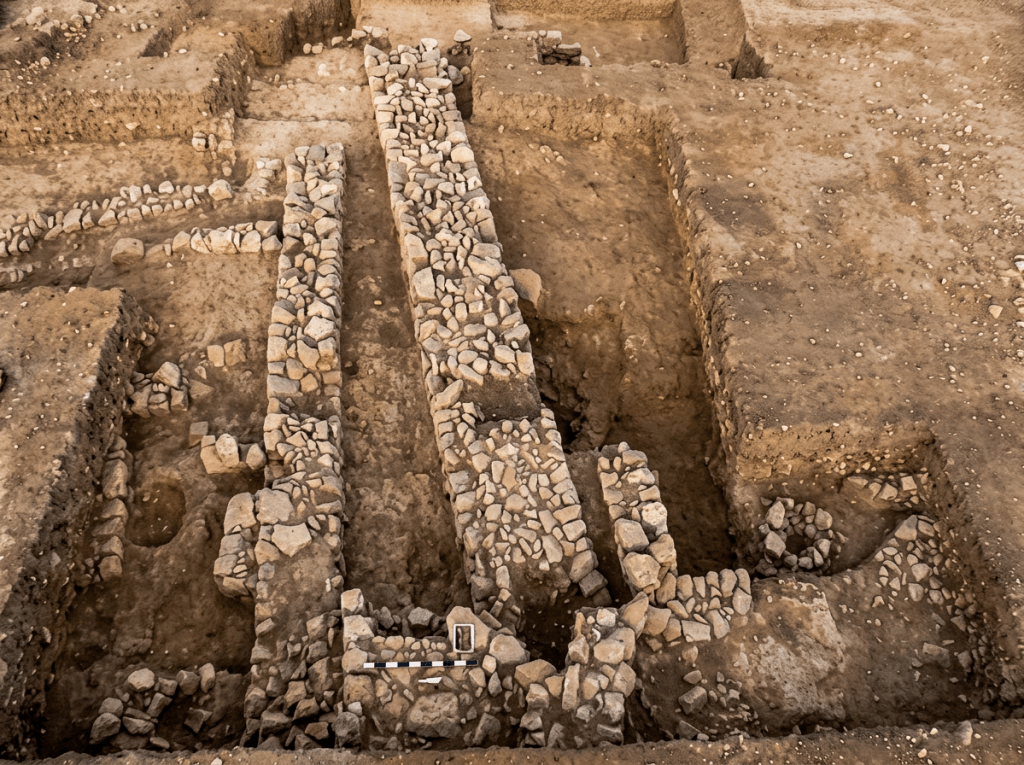
The site of Ain Ghazal provides a different perspective. Located near modern-day Amman, Jordan, the settlement became one of the largest Neolithic communities in the Near East during the eighth and seventh millennia BCE (Rollefson, 2001). Population growth brought opportunities but also challenges. Researchers have suggested that increasing demands on local forests, agricultural land, and grazing resources contributed to environmental pressures. Eventually, the settlement contracted significantly in size. Ain Ghazal illustrates that larger populations did not automatically produce greater stability. Growth itself could create vulnerabilities.

Agriculture Was Not Always an Improvement
For many years, farming was assumed to represent an obvious improvement over hunting and gathering. Recent research has complicated this view. Early agricultural communities often experienced more physically demanding labor, reduced dietary diversity, increased exposure to disease, greater dependence on local environmental conditions and periodic food shortages (Cohen & Armelagos, 1984). While agriculture supported larger populations, it also introduced new risks. Settled life required constant management and maintenance. In this sense, farming communities may have been conducting a long-term experiment whose outcomes were not always positive.
Climate and Environmental Uncertainty
Neolithic settlements existed within dynamic environments. Communities faced droughts, floods, soil depletion, changing vegetation and resource shortages. Even small climatic fluctuations could have major consequences for populations dependent upon local agriculture and livestock. Evidence from the Near East suggests that environmental changes periodically reshaped settlement patterns throughout the Neolithic period (Roberts, 2014). Many communities adapted successfully. Others did not.
Social Experiments in Organization
One of the most fascinating aspects of the Neolithic period is the diversity of social arrangements. Different settlements experimented with household-based organization, collective labor systems, ritual centers, trade networks and different levels of hierarchy. For example, Çatalhöyük appears relatively egalitarian compared with later urban societies, while other communities show emerging forms of social differentiation (Hodder, 2006). This diversity suggests that no single model of social organization dominated the Neolithic world. People were actively exploring alternative ways of living together.

Abandonment Was Common
Archaeological evidence demonstrates that abandonment was not unusual. Settlements might be left behind because of environmental stress, resource exhaustion, disease, conflict, social reorganization and migration opportunities. Abandonment should not necessarily be viewed as failure. In many cases, relocating may have been a rational and effective strategy. Early communities were often more mobile and adaptable than modern assumptions suggest.

Learning Through Trial and Error
Viewed from a long-term perspective, Neolithic societies resemble a vast process of experimentation. Communities tested new crops, new building techniques, new settlement layouts, new social structures and new economic relationships. Some approaches spread widely. Others disappeared. The archaeological record preserves evidence of both successful and unsuccessful experiments. This process of trial and error played a crucial role in shaping later civilizations.
Rethinking Progress
Modern discussions often assume that complexity, urbanization, and state formation represent inevitable outcomes of human development. Yet many Neolithic communities followed different trajectories. Some remained small for centuries. Some grew and later declined. Others developed elaborate symbolic cultures without becoming centralized states. Research increasingly suggests that history was not moving toward a predetermined destination (Graeber & Wengrow, 2021). Instead, human societies continually made choices within changing environmental and social conditions. The earliest settlements were not simply stepping stones toward civilization. They were ambitious experiments in living, cooperation, agriculture, architecture, and social organization.
Sites such as Jericho, Ain Ghazal, and Çatalhöyük reveal that settled life was often fragile, requiring constant adaptation to environmental pressures, demographic change, and social challenges. Many communities succeeded for centuries, while others contracted, relocated, or disappeared altogether.
Rather than viewing the Neolithic as a story of linear progress, it may be more accurate to see it as a period of remarkable innovation and experimentation. The people who built the first villages were not following a predetermined path toward cities and states. They were exploring possibilities, solving problems, and creating new ways of living—many of which remain relevant to societies today.

References: Bocquet-Appel, J. P. (2011). When the world’s population took off: The springboard of the Neolithic Demographic Transition. Science, 333(6042), 560–561.
Childe, V. G. (1936). Man Makes Himself. Watts & Co.
Cohen, M. N., & Armelagos, G. J. (Eds.). (1984). Paleopathology at the Origins of Agriculture. Academic Press.
Graeber, D., & Wengrow, D. (2021). The Dawn of Everything: A New History of Humanity. Farrar, Straus and Giroux.
Hodder, I. (2006). The Leopard’s Tale: Revealing the Mysteries of Çatalhöyük. Thames & Hudson.
Hodder, I. (2018). Where Are We Heading? The Evolution of Humans and Things. Yale University Press.
Roberts, N. (2014). The Holocene: An Environmental History (3rd ed.). Wiley-Blackwell.
Rollefson, G. O. (2001). The Neolithic period. In B. MacDonald, R. Adams, & P. Bienkowski (Eds.), The Archaeology of Jordan (pp. 67–105). Sheffield Academic Press.
Leave a Reply