< home # store # services # articles # game # app #contact >

The domestication of apples (malus domestica) is a fascinating and complex process that began during the neolithic era. It likely involved both natural hybridization and human selection across a wide geographic range
Apple remains have been found in neolithic lake dwellings in Switzerland.
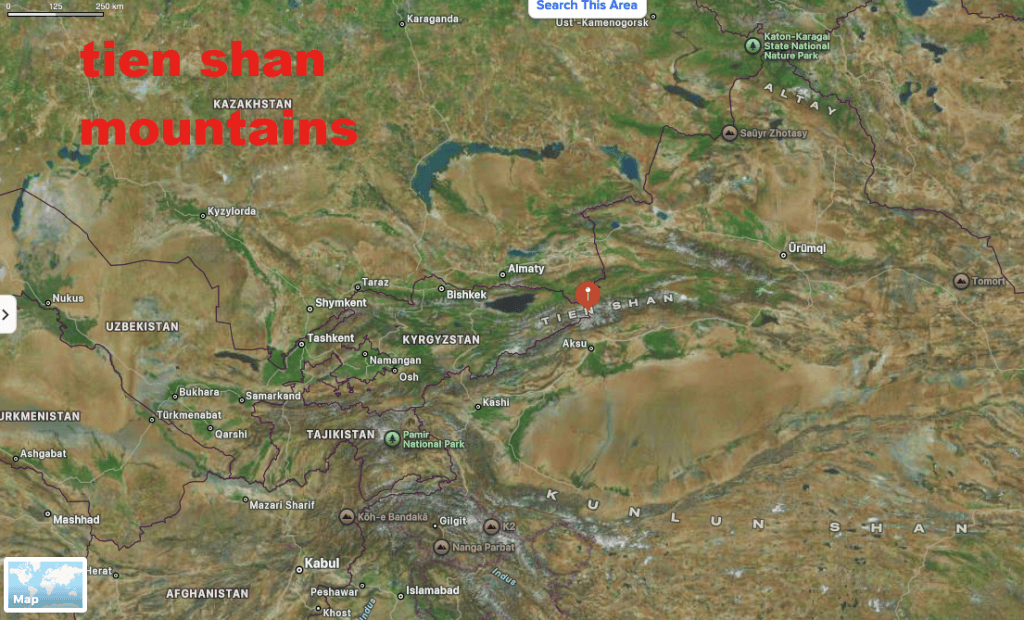
The modern cultivated apple descends mainly from its primary ancestor Malus sieversii, a wild apple species still found in the mountains of Central Asia, particularly southeastern Kazakhstan, Kyrgyzstan, and parts of China
These apples can be large and sweet, unlike many other small and bitter wild apples.
As traders, herders, and travelers moved along the Silk Road, they carried apple seeds and grafts westward. This allowed wild M. sieversii to hybridize with other wild crabapple species: Malus orientalis (Caucasus and Near East), Malus sylvestris (Europe), Malus baccata (Siberia and East Asia). These crossings enriched the gene pool and led to a more diverse range of fruit shapes, sizes, and flavors.
Initial human use
Early farmers and foragers in Central Asia likely began selecting sweeter, larger-fruited wild trees, consuming the fruits, spreading the seeds and grafts
Vegetative propagation: unlike grains, apples do not breed true from seed — a tree grown from seed often produces apples very different from its parent
As a result, joining cuttings onto rootstock, or grafting, became a crucial technique. Helping preserve desirable varieties.
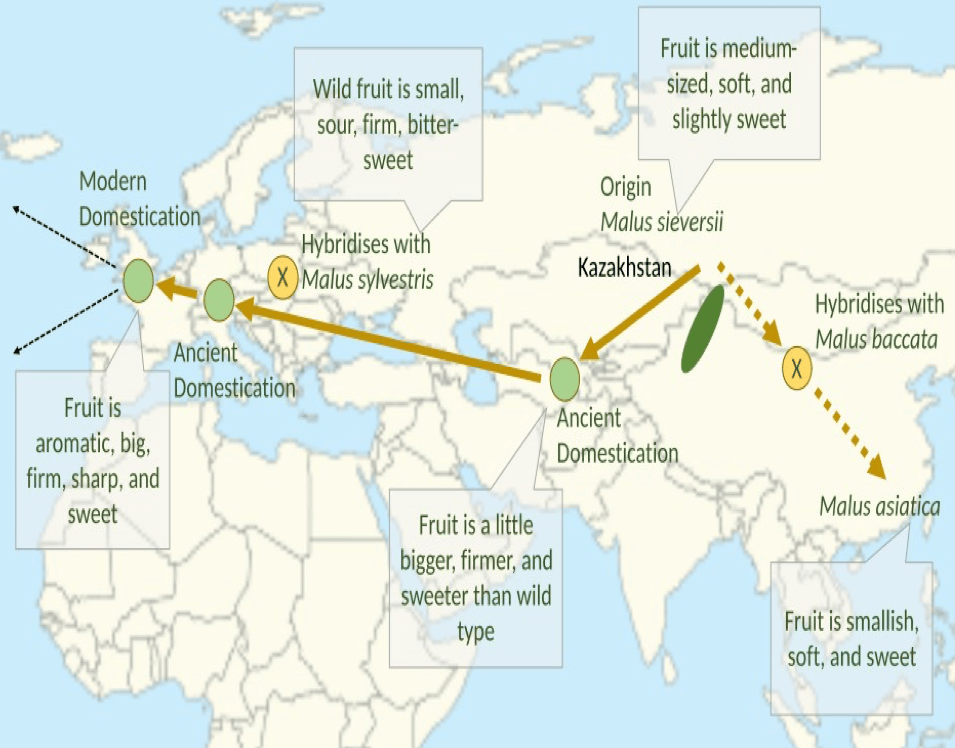
Apples spread to the Middle East and Europe via trade and migration
By Roman times, many cultivated apple varieties were well-established across the Mediterranean and Europe.
Did you know? In the medieval Islamic world, apple cultivation expanded with agricultural innovations. In Europe, monasteries and later estates maintained orchards and improved varieties.
Modern genomic studies confirmed that: Malus sieversii is the primary progenitor
Introgression from other species gave apples: Better storage life; Improved flavor profiles; Greater resistance to disease and climate.
The domestication of apples was: Long and multi-regional, driven by natural hybridization and human selection, enabled by the silk road, and early horticultural techniques like grafting. The result is a highly diverse and globally cultivated fruit.
Bibliography: “Origin and history of “apple” by Online Etymology Dictionary” (https://www.etymonline.com/word/apple). Online Etymology Dictionary. Archived (https://web.archive.org/web/20191221020212/https://www.etymonline.com/word/apple)
Richards, Christopher M.; Volk, Gayle M.; Reilley, Ann A.; Henk, Adam D.; Lockwood, Dale R.; et al. (2009). “Genetic diversity and population structure in Malus sieversii, a wild progenitor species of domesticated apple”. Tree Genetics & Genomes. 5 (2): 339–347. doi:10.1007/s11295-008-0190-9 (https://doi.org/10.1007%2Fs11295-008-0190-9). S2CID 19847067 (https://api.semanticscholar.org/CorpusID:19847067)
Rieger, Mark. “Apple – Malus domestica” (https://web.archive.org/web/20080121045236/http://www.uga.edu/fruit/apple.html). HORT 3020: Intro Fruit Crops. University of Georgia. Archived from the original (http://www.uga.edu/fruit/apple.html)
Lauri, Pierre-éric; Maguylo, Karen; Trottier, Catherine (March 2006). “Architecture and size relations: an essay on the apple (Malus × domestica, Rosaceae) tree” (https://bsapubs.onlinelibrary.wiley.com/doi/full/10.3732/ajb.93.3.357). American Journal of Botany. 93 (3): 357–368.doi:10.3732/ajb.93.3.357 (https://doi.org/10.3732%2Fajb.93.3.357). PMID 21646196 (https://pubmed.ncbi.nlm.nih.gov/21646196). Archived (https://web.archive.org/web/20190420154707/htt
ps://bsapubs.onlinelibrary.wiley.com/doi/full/10.3732/ajb.93.3.357)
Cornille, Amandine; Gladieux, Pierre; Smulders, Marinus J. M.; Roldán-Ruiz, Isabel; Laurens, François; et al. (2012). Mauricio, Rodney (ed.). “New Insight into the History of DomesticatedApple: Secondary Contribution of the European Wild Apple to the Genome of Cultivated Varieties” (https://www.ncbi.nlm.nih.gov/pmc/articles/PMC3349737). PLOS Genetics. 8 (5):e1002703. doi:10.1371/journal.pgen.1002703 (https://doi.org/10.1371%2Fjournal.pgen.1002703). PMC 3349737 (https://www.ncbi.nlm.nih.gov/pmc/articles/PMC3349737). PMID 22589740 (https://pubmed.ncbi.nlm.nih.gov/22589740).
Kean, Sam (17 May 2012). “ScienceShot: The Secret History of the Domesticated Apple” (https://www.science.org/content/article/scienceshot-secret-history-domesticated-apple). Archived (https://web.archive.org/web/20160611184017/http://www.sciencemag.org/news/2012/05/scienceshot-secret-history-domesticated-apple)
Duan, Naibin; Bai, Yang; Sun, Honghe; Wang, Nan; Ma, Yumin; et al. (2017). “Genome re-sequencing reveals the history of apple and supports a two-stage model for fruit enlargement” (https://www.ncbi.nlm.nih.gov/pmc/articles/PMC5557836). Nature Communications. 8 (1): 249. Bibcode:2017NatCo…8..249D (https://ui.adsabs.harvard.edu/abs/2017NatCo…8..249D).doi:10.1038/s41467-017-00336-7 (https://doi.org/10.1038%2Fs41467-017-00336-7.PMC) 5557836 (https://www.ncbi.nlm.nih.gov/pmc/articles/PMC5557836). PMID 28811498 (https://pubmed.ncbi.nlm.nih.gov/28811498
Rottoli, Mauro; Pessina, Andrea (2007). “Chapter 9: Neolithic agriculture in Italy: an update of archaeobotanical data with particular emphasis on northern settlements”. In Colledge, Sue; Conolly, James (eds.). The Origins and Spread of Domestic Plants in Southwest Asia and Europe (https://archive.org/details/originsspreadofd0000unse) (First ed.). Walnut Creek, California: Left Coast Press; University College London Institute of Archaeology Publications. Pg. 142–143. ISBN 978-1-59874-988-5. OCLC 84838157 (https://search.worldcat.org/oclc/84838157
Lord, William G.; Ouellette, Amy (February 2010). “Dwarf Rootstocks for Apple Trees in the Home Garden” (https://web.archive.org/web/20130930151829/http://extension.unh.edu/resources/files/Resource000583_Rep605.pdf) (PDF). University of New Hampshire. Archived from the original (http://extension.unh
Leave a Reply