<home # start here # guides # builds # services # shop # about # categories>
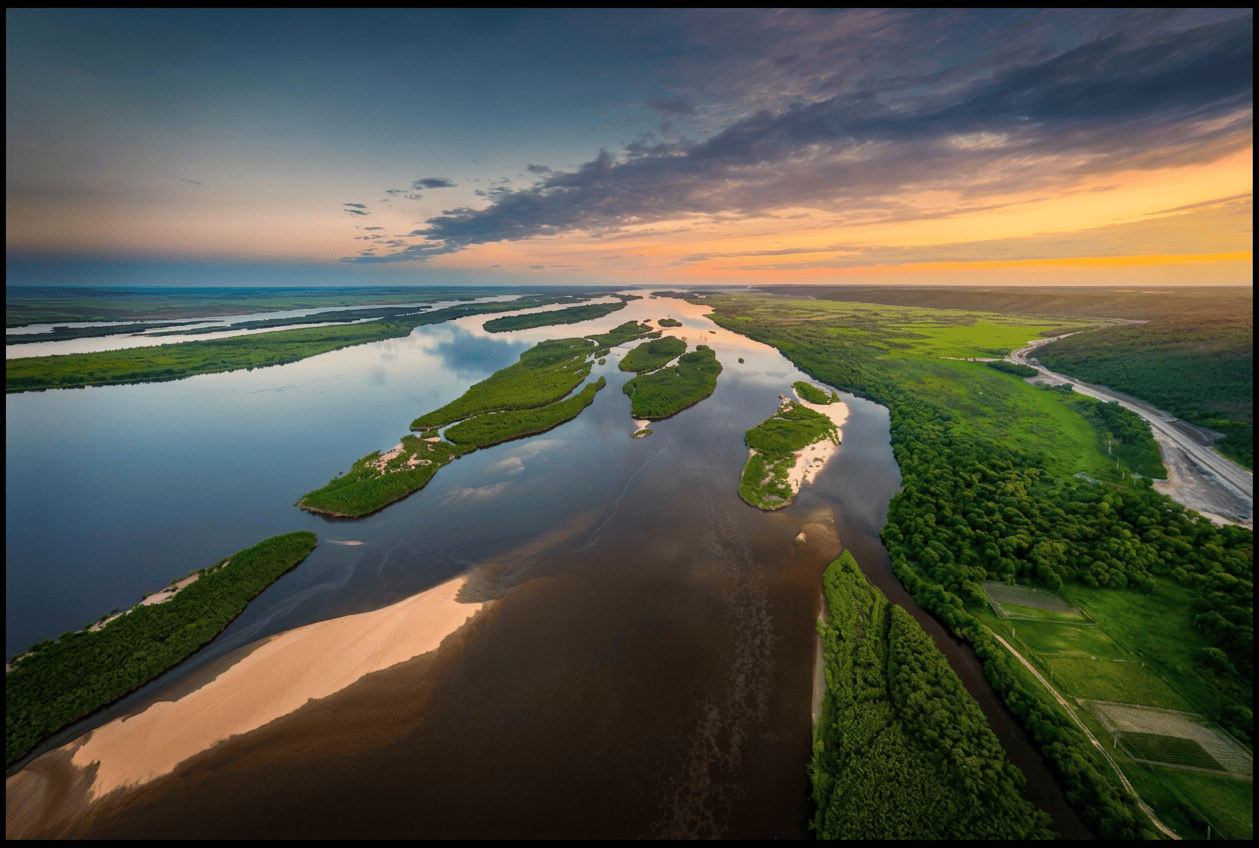
Long before the great farming villages of Mesopotamia, Anatolia or the Levant, people living beside the Amur River in eastern Eurasia were already making pottery
They were not farmers. They did not grow wheat. They did not herd sheep. They did not raise cattle. They did not live in cities. They were hunter-fisher-gatherers living through the extraordinary climatic instability of the end of the last Ice Age. Yet they made clay cooking vessels. They built shelters. They used hearths. They manufactured sophisticated stone and bone tools. They hunted large mammals. They exploited fish—including migratory salmonids. They gathered plants. And, they participated in exchange networks that moved stone over hundreds of kilometres.
The archaeological traditions known as Osipovka and Gromatukha therefore provide one of the most important alternative stories of the Neolithic
Their story is not: farming, village, house and town. It is: climate change, river resources, mobility, fishing and hunting, pottery and increasingly complex seasonal settlements.
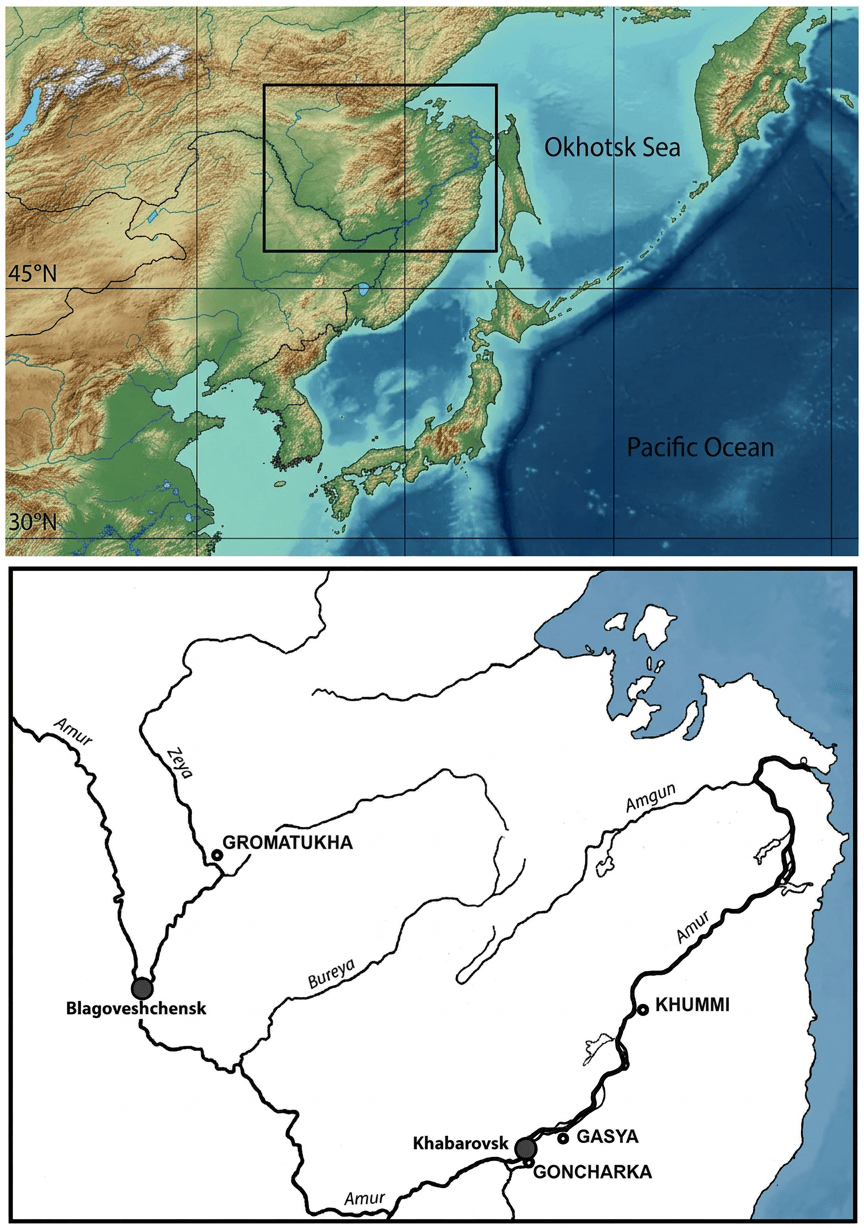
First: where were these people and where is the Amur River?
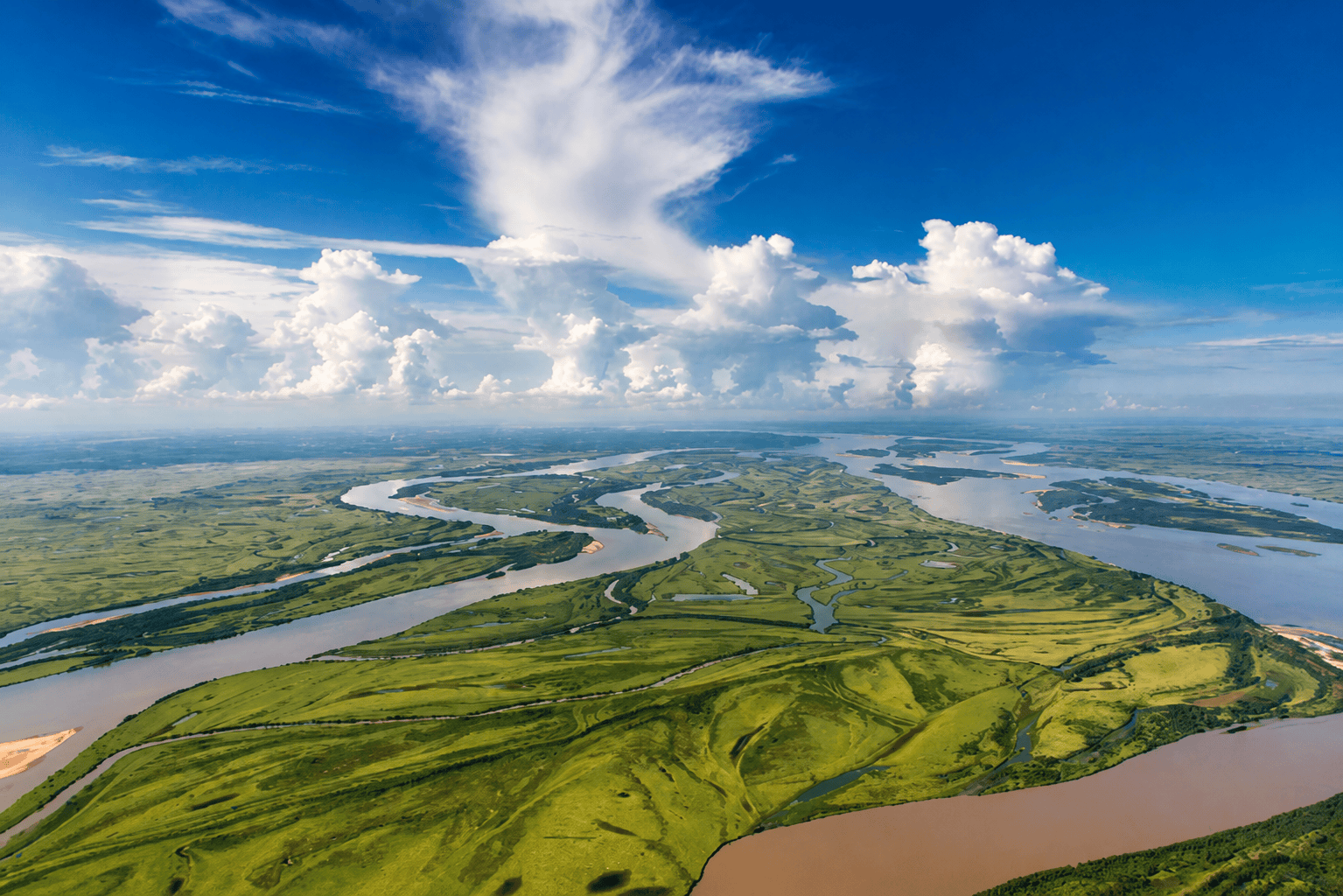
The Amur river, known in China as the Heilong Jiang—is one of the great rivers of northeastern Asia. It eventually flows toward the Sea of Okhotsk. The archaeological cultures discussed here occupied different parts of its enormous drainage basin.
Osipovka
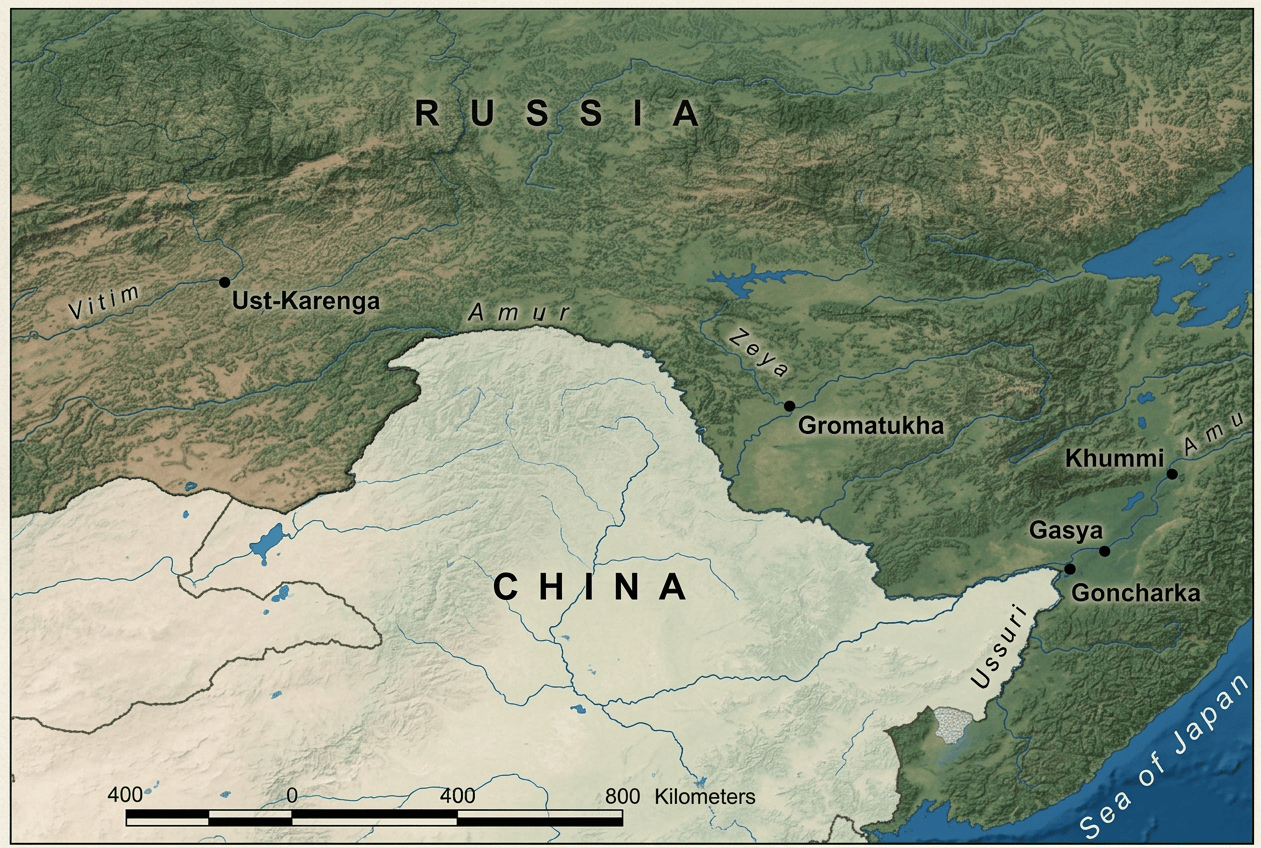
The Osipovka complex was concentrated in the Lower Amur basin, especially around the region where the Amur and Ussuri Rivers meet and farther downstream. Important sites include: Gasya, Khummi, Goncharka-1, Novotroitskoye 10 and Osinovaya Rechka. [1,3]
Gromatukha
The Gromatukha complex was farther upstream in the Middle Amur basin, particularly around the Zeya River. The type-site, Gromatukha, lies at the confluence of the Gromatukha and Zeya Rivers, on a high river terrace. Its approximate coordinates are 51°49′ N, 128°49′ E. [3,6] The site is therefore not “central Russia.” It is in the Russian Far East, in the enormous river system connecting Siberia, Manchuria and the Pacific world.
The Amur River is the defining geographical characteristic
The Lower Amur Osipovka sites were situated directly along the Amur or its immediate tributaries.
Gromatukha was situated on the Zeya, one of the major tributaries of the Middle Amur. [3,6]
The river was much more than scenery. It was food source, transportation route, raw-material source, animal corridor and communication route. This is one of the best prehistoric examples of what might be called river architecture.
Was it near mountains? Yes but the two cultural areas differ
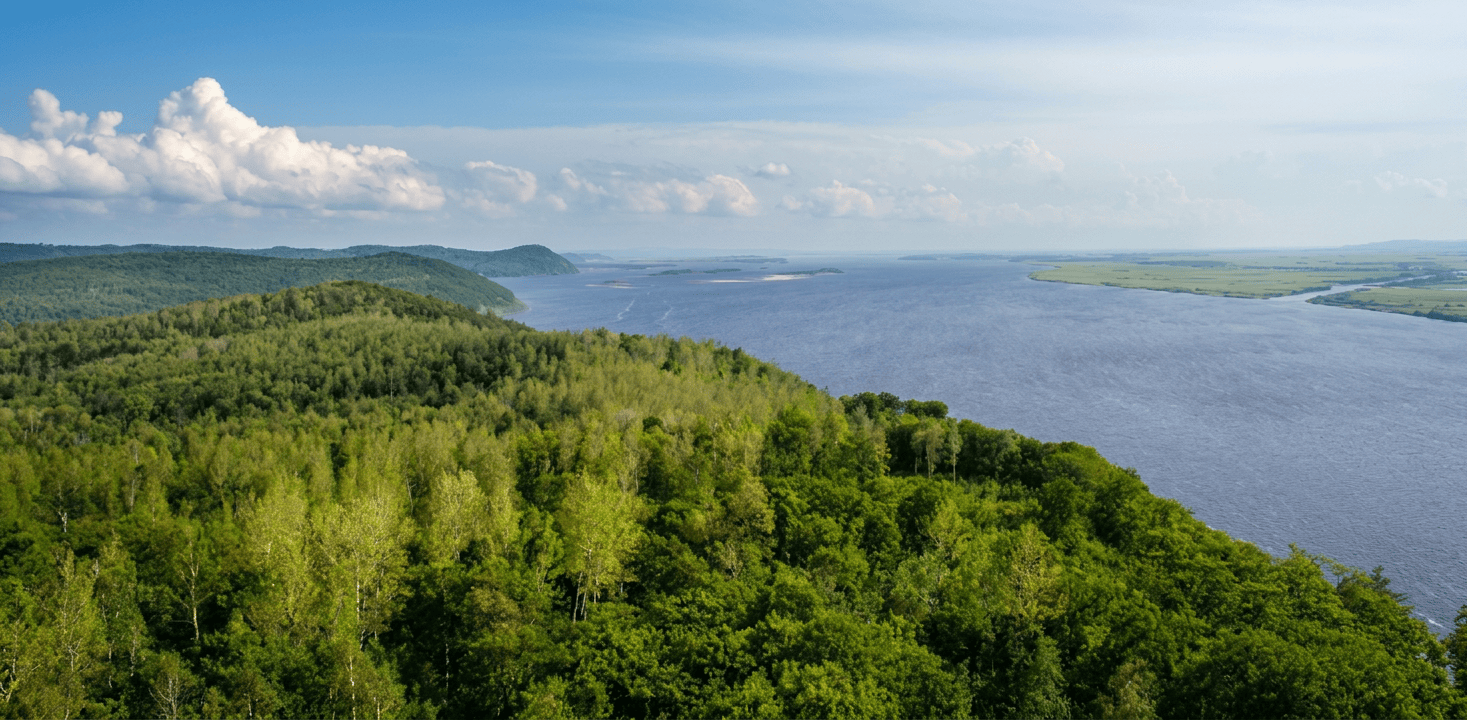
The Middle Amur/Zeya region is associated with uplands and mountain systems farther west and north, while the Lower Amur opens into extensive lowlands. The Gromatukha type-site itself was located on a river terrace rather than in a high mountain valley. [3,6] The broader Amur basin forms an enormous transition between mountains, forest, river valleys, floodplains, wetlands and lowlands. This ecological diversity was extraordinarily important to hunter-gatherers.
Was this an extreme environment?
During the period of the earliest pottery, yes climatically. But it is important not to imagine today’s Amur landscape simply covered in ice. The earliest pottery appears during the Late Glacial, when the climate was still highly unstable. The region experienced major fluctuations associated with the final stages of the Ice Age, including the Bølling–Allerød warming and the Younger Dryas cooling. [5,7] Vegetation changed substantially. Early phases included relatively open landscapes and light coniferous woodland; later phases saw expansion of coniferous and mixed forests. [7] So people were living through a rapidly changing environmental system.
The Younger Dryas is especially important
Around 12,900–11,700 years ago, much of the Northern Hemisphere experienced a sudden return to colder conditions after the initial postglacial warming. The Amur region was affected as well. For hunter-gatherers, this could mean changes in animal distributions, altered vegetation, shorter productive seasons, changes in fish availability and greater uncertainty in terrestrial hunting.
The appearance and increasing importance of pottery occurred during this broad period of environmental instability. That does not prove that climate change “caused” pottery. But the coincidence is striking. [5,7,8]
The great surprise: this was not an agricultural Neolithic
The word Neolithic can be misleading here. In Russian Far Eastern archaeology, the appearance of pottery has traditionally been one of the principal criteria for defining the beginning of the Neolithic. [5] But Osipovka and Gromatukha were still fundamentally hunter-fisher-gatherer societies.
There is no evidence that these earliest communities were farming wheat or barley. There is no evidence for herding sheep or goats. There is no evidence for domesticated cattle. There is no evidence for domesticated pigs. There is no evidence for horse domestication. [2,5] This is therefore a ceramic Neolithic without agriculture.

Plants still mattered
No agriculture does not mean no plant economy. The archaeological and environmental evidence suggests exploitation of wild plants. As forests expanded, researchers have suggested that people could increasingly exploit seasonally available plant resources, including nuts such as Manchurian walnut (Juglans mandshurica) in the wider Amur environment. [4] However, preservation is poor. The acidic soils of the Russian Far East destroy much organic material, making direct reconstruction of plant diets difficult. [2,4] Therefore: wild plant gathering is well supported; particular plant species should be treated more cautiously unless directly identified.
Reindeer, deer, boar and horse
The Gromatukha site provides unusually useful faunal evidence. Animal remains include: red deer (Cervus elaphus), roe deer (Capreolus), wild boar (Sus scrofa), Equus species and fish. [4,5]
The Equus remains are important. But they should not be called domesticated horses. They represent wild equids.
Likewise: wild boar does not equal domestic pig. This distinction is essential.
Fish were crucial
The Lower Amur was exceptionally rich in aquatic resources. The modern Amur supports more than 100 freshwater fish species, together with anadromous fish such as salmon that migrate upriver to spawn. [2] This ecological richness has a very long history. The archaeological evidence indicates that fish were important to the Osipovka economy. At Gasya, net sinkers were recovered from early Neolithic contexts, providing direct technological evidence for fishing. [5] And, the chemistry of the pottery tells an even more remarkable story.

What was inside the pots?
Scientists can now recover ancient fats from microscopic residues absorbed into pottery. Researchers analysed pottery from: Gasya, Khummi, Goncharka-1 and Gromatukha. The result was striking.
Lower Amur / Osipovka
Pottery was strongly associated with the processing of aquatic resources, including salmonids and other fish. [2]
Middle Amur / Gromatukha
Pottery showed a much stronger contribution from ruminant animal fats. In other words: Lower Amur pots = fish. Middle Amur pots = land animals. At least as a broad pattern. [2,4] This is one of the most exciting discoveries in the archaeology of early pottery.
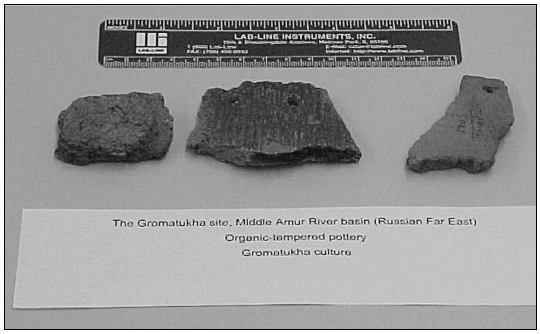
Why make pottery if you are a hunter-gatherer?
Because a cooking pot is incredibly useful. It allows people to: boil food, extract fat, soften tough meat, process fish, process marrow, combine ingredients and preserve or process seasonal resources.
For salmon-rich environments, pottery could have been particularly valuable for extracting oil and fat from fish.
For hunters farther upstream, pots could be used to process fatty parts of large animals. The same invention therefore solved different nutritional problems in different parts of the river system. [2]
Some of the world’s oldest pottery. A real superstar of the Amur cultures
Pottery from the Osipovka and Gromatukha complexes is approximately 13,000 years old in conventional radiocarbon terms, equivalent to roughly 16,000 calendar years ago. [2,5] This places the Russian Far East among the world’s earliest pottery-producing regions. Other early pottery traditions appear in Japan, southern China and the Russian Far East. [2,5] And, this happened before agriculture.
That fact alone overturns the old idea that pottery was invented because farmers suddenly needed storage jars.
Osipovka pottery
The earliest Osipovka vessels were relatively crude by later standards. One reconstructed Gasya vessel was approximately: 25–27 cm high, flat-bottomed, around 5.5–6 litres in volume with thick walls, approximately 1.2–1.7 cm thick. [5] The vessel was plant-fibre tempered. Its surface had vertical grooves. Soot on the vessel indicates exposure to fire, consistent with cooking. [5] This was not fine tableware. It was a rugged cooking technology.
Gromatukha pottery
Gromatukha pottery was technologically distinct from Osipovka pottery. The vessels were generally: flat-based or rounded/flat-bottomed, relatively thick, plant-fibre tempered, decorated with grooves, cord impressions or other surface treatments. A distinctive feature of the Gromatukha tradition is a form of “sandwich” construction, in which plant fibres were incorporated between layers of clay. [3,4] This is fascinating from a building-technology perspective. The potter was essentially making a composite material. Clay supplied structure. Organic material modified the body. Controlled firing transformed the mixture into ceramic. That is materials engineering.
Did they build houses?
Yes—but the evidence varies enormously by site. This is where it becomes particularly useful to distinguish Osipovka from Gromatukha.
Osipovka houses: surface shelters
At the Gasya site, archaeologists identified two possible dwelling areas. They were dark, charcoal-stained areas approximately: 3.5 × 4.5 m; and, 1.5 × 5.0 m. They were associated with concentrations of archaeological material. [9] The excavators interpreted these as possible surface dwellings, probably constructed from wood and animal hides. This is an important reconstruction. It suggests a light structural frame covered with organic material. Not masonry. Not mudbrick. Not a permanent stone house.
Khummi: a partly sunken house
At Khummi, however, the architecture becomes more substantial. Two rectangular dwellings were identified in Younger Dryas layers. One was sunk approximately 20–22 cm into the ground. There were approximately nine postholes associated with the dwelling complex. The houses also contained stone-outlined hearths. [9,10] This is strong evidence for a combination of: earth, posts, timber/organic superstructure and fire. It is much closer to a genuine architectural building than the simple surface shelters at Gasya.
So: subterranean or surface?
Both possibilities existed within the Osipovka settlement system. The evidence suggests at least two forms: 1. Surface shelters. Likely using: wood/poles, branches and hides.
2. Semi-subterranean rectangular dwellings. With: shallow sunken floors, posts and stone-lined hearths. [9,10] The semi-subterranean examples were not enormous. A depression only 20–22 cm deep is not a giant underground house. It is better thought of as a slightly sunken thermal and structural platform.
Was this sophisticated heating technology?
For its time, the combination is quite clever. A shallow depression reduces the amount of wall exposed to wind. A lightweight organic roof/wall system provides insulation. A hearth supplies heat. Stone around the hearth stabilizes and protects the fire installation. The result is a low-energy shelter. It is not “central heating.” But it is a remarkably efficient human-scale thermal system.
What about smoke?
There is no good evidence from the Osipovka dwellings for the sophisticated smoke-hole systems known from some later northeastern Asian pit houses. This is important because Novopetrovka, a later Amur tradition, provides clearer evidence for substantial semi-subterranean houses with central hearths and smoke-hole entrances. [11] So don’t transfer Novopetrovka architecture backward and label it Osipovka. The early Osipovka evidence is simpler: shallow depression + posts + hearth + organic superstructure.
Gromatukha houses
The Gromatukha type-site is different. Archaeologists found hearth concentrations, utility pits, working areas and concentrations of stone artefacts. But there is no securely excavated substantial house structure at the type-site comparable with the later Novopetrovka pit houses. [10,12] The evidence has therefore been interpreted as consistent with temporary or portable tent-like dwellings. This fits a mobile or semi-sedentary hunting economy.
What did a Gromatukha tent look like?
We cannot know exactly. But the archaeological pattern is consistent with a lightweight shelter constructed from: poles, branches, hides or other organic coverings. The important point is that there is no archaeological evidence for mudbrick or stone masonry houses at Gromatukha. A reconstructed house should therefore look much more like a northern hunter-gatherer shelter than a Near Eastern mud-brick village.
There is no evidence for wattle-and-daub, mudbrick or stone houses
Stone was important for tools and hearths, but not as the principal wall-building material. It was used inside the technological system, not as masonry architecture.
The evidence points much more strongly toward: light timber/pole + hide/organic construction. That distinction matters. This is one of the clearest contrasts with early farming villages in the Fertile Crescent.
Timber frame?
Yes, in the broad sense of pole/timber structural frameworks. Postholes at Khummi provide evidence for structural supports. But it would be premature to reconstruct a sophisticated European-style timber-frame house with pegged joints, sill beams and framed panels.
Hearths
Hearths are among the most important architectural features. At Khummi, hearths were stone-outlined. [9,10] At Gromatukha, charcoal concentrations probably represent hearths. These hearths created localized activity zones. Around them were: stone tools, pottery, food-processing areas and manufacturing debris. The hearth was therefore the centre of the household.
Storage pits
Utility pits occur at Gromatukha. These may have been used for storage, refuse, processing and other household purposes. But their precise functions are not always recoverable. A pit should therefore not automatically be called a food-storage cellar.
Was there communal architecture?
There is no large communal hall comparable with the monumental communal structures of Göbekli Tepe or early Jericho. Nor is there a clearly identified temple. Instead, social aggregation seems to have occurred around productive landscapes. The river itself supplied the shared infrastructure. Seasonal fishing areas could bring people together. Hunting opportunities could aggregate groups. The cemetery or special activity area could become socially important. This is communal organization without monumental buildings.
Ritual activity: There are intriguing hints of ritual behavior
At Goncharka-1, for example, archaeologists identified unusual non-utilitarian complexes, including a possible burial and anthropomorphic objects. [13] Osipovka sites also produced unusual portable art. But these should not be transformed into a claim for a formal temple. The strongest conclusion is: symbolic and ritual activity existed, but monumental communal architecture is not demonstrated.
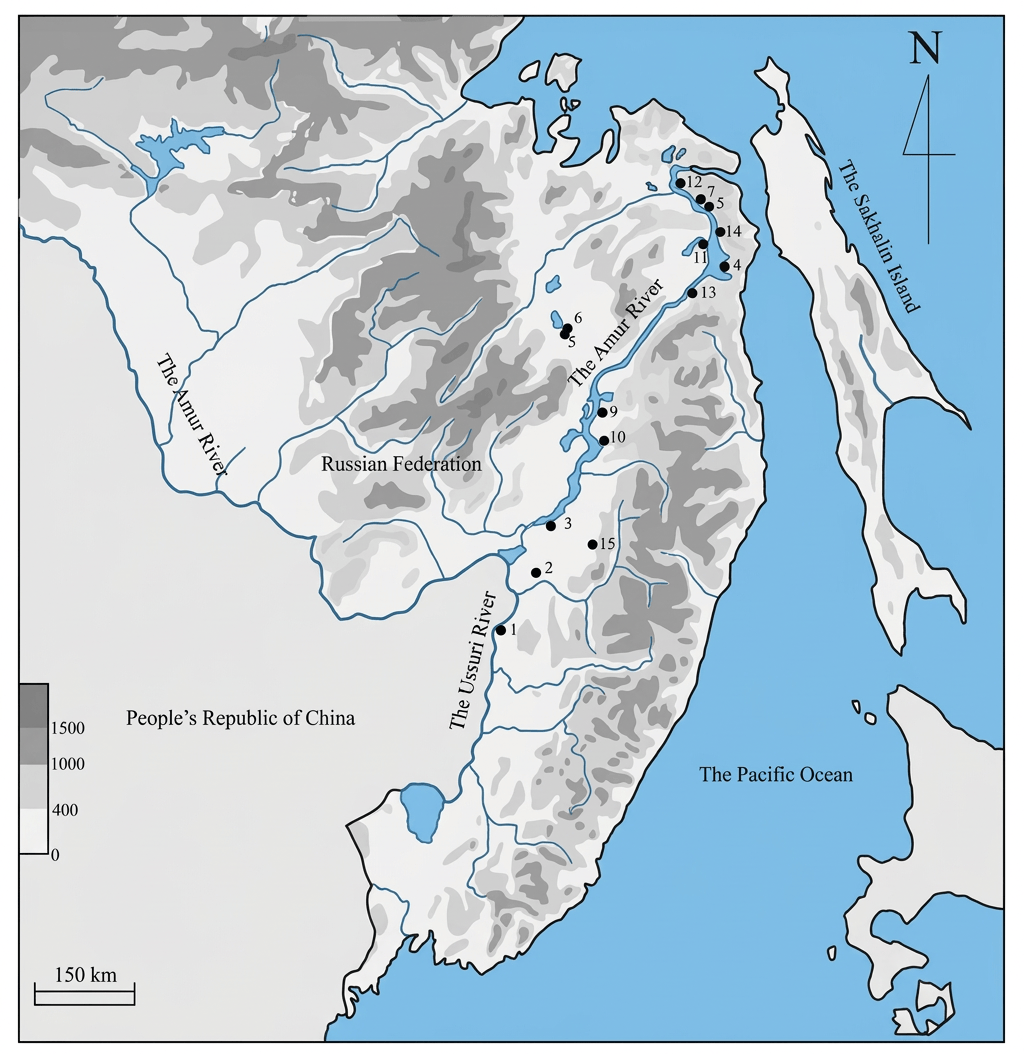
Sheremetyevo; 2 – Kiya; 3 – Sikachi-Alyan, Malyshevo, Gasya; 4 – Suchu; 5 – Mari-5; 6 – Kondon; 7 – Susanino-4; 8 – Malaya Gavan; 9 – Voznesenskoye; 10 – Innokent-yevka; 11 – Kolchem-3; 12 – Takhta; 13 – Kalinovka; 14 – Auri; & 15 – Sukpai
Figurines
Yes—this is one of the fun parts. Osipovka-associated portable art includes small animal representations. At Gasya, a small burned-clay bear figurine was found. Other Osipovka-associated sites produced bird representations, including a stone bird figurine. [14] These are remarkable because they show that the people were not only manufacturing tools. They were making images.
Why bears and birds?
The animals represented were part of the living environment. A bear was: dangerous, powerful, edible
fur-bearing and ecologically significant. Birds were: seasonal, migratory and visually distinctive. The creation of animal images suggests that the natural world was not merely an economic resource. It was also part of a symbolic universe.
Human figures
Some unusual anthropomorphic or symbolic objects occur within the wider Osipovka tradition. Goncharka-1 produced stones with simple pecked “face” motifs, while basalt objects with anthropomorphic characteristics have also been reported from burial contexts. [14] These objects are fascinating but difficult to interpret. They should be described as: anthropomorphic/symbolic object. Rather than confidently calling them gods, ancestors or shamans.
Ochre and burials
Burials occur in the wider Lower Amur archaeological record. There is evidence for unusual mortuary treatment, including a possible burial with fire at Goncharka-1. [13] But Osipovka should not be portrayed as an ochre-dominated cemetery in the manner of some Early Neolithic Baikal traditions. The evidence is more varied.
Weapons
The people had an impressive hunting toolkit. It included: bifacial projectile points, spear points, arrowheads, knives, scrapers, microblades and burins. The stone technology combines older microblade traditions with increasingly substantial bifacial and ground-stone tools. [3,10] This is a very interesting technological transition.
Microblades. Inherited from Late Paleolithic technological traditions
Microblades could be inserted into composite tools. That means a hunter could carry a relatively compact toolkit while having access to replaceable cutting edges. Excellent technology for mobile hunter-gatherers.
Ground stone tools
Ground and polished tools became increasingly important. These included: axes, adzes, grinding stones, hammerstones and anvils. At Khummi, groundstone axes/adzes and other woodworking equipment occur alongside chipped stone technology. [10] This combination suggests increasing investment in woodworking, shelter construction and equipment manufacture.
Yes—obsidian was used in the Amur basin
Geochemical sourcing has demonstrated prehistoric movement of volcanic glass between sources and archaeological sites over substantial distances. The major Amur source is the Obluchie Plateau. Other sources include: Basaltic Plateau, Samarga and, farther afield, sources in Hokkaido such as Shirataki. Transport distances within the Amur system reached approximately 50–750 km, while some external source networks extended much farther. [15] This is genuine evidence of prehistoric exchange.
At least one Gromatukha obsidian artefact has been geochemically analysed and assigned to an Amur basin source [15]
That means the Middle Amur was not technologically isolated. People were obtaining volcanic glass from distant geological sources.
There were also extensive regional interaction networks linking the Amur basin with Manchuria/northeastern China
But we should not imagine a Bronze Age-style merchant caravan. Exchange probably involved a combination of: movement of people, gifts, social alliances, seasonal aggregation, marriage networks and direct exchange. Obsidian provenance demonstrates movement of materials; it does not tell us precisely which social mechanism moved each object. [15]
The connection with Japan is especially interesting
The Russian Far East, Japan and southern China are all regions where very early pottery appeared independently or near-independently during the Late Glacial. The pottery traditions are not identical. Researchers increasingly emphasize parallel technological innovation rather than assuming that one population invented pottery and simply exported the idea everywhere. [2,4] That is a major archaeological lesson. Sometimes different people solve the same problem independently.
Hokkaido obsidian
Later prehistoric exchange networks demonstrably moved Hokkaido obsidian into the Amur region. The Shirataki source on Hokkaido is especially important. Some Amur-region sites contain obsidian from distant sources, demonstrating that people could move high-quality volcanic glass across hundreds of kilometres of Northeast Asia. [15] The exact chronology of every individual artefact must still be checked, however.
Nephrite and other hard stones were used in the broader Far Eastern Neolithic
The most important point is that the Amur technological system was not dependent on one raw material. People selected materials according to: fracture properties, hardness, edge quality, durability and availability. River gravel was an important local resource. The geological landscape was effectively a prehistoric hardware store.
They didnt have gold. There valueable objects including things such as: good stone, obsidian, antler, bone, shells, carefully manufactured tools, pottery and animal imagery.
Shell ornaments and stone beads/pendants occur in the broader Lower Amur assemblages
At Khummi, for example, stone beads and pendants have been reported alongside the technological assemblage. [10] These demonstrate that personal ornamentation mattered even in mobile hunter-gatherer communities.
Was there a watercraft tradition?
This is fascinating—but the evidence is indirect. There is no preserved Osipovka dugout canoe waiting in a museum. Wood rarely survives in these acidic archaeological deposits. Nevertheless, the economic geography strongly favors water transport. The communities occupied the banks of enormous rivers. They were fishing. They were moving between tributaries. They were processing aquatic resources. They were exchanging stone over considerable distances. It would be surprising if they did not possess some form of watercraft. But the academically safe statement is: Riverine mobility is strongly supported; specific boat construction is not archaeologically demonstrated.
Reconstruction might consider: dugout canoe, bark boat or skin-covered frame boat
Each requires assumptions. A dugout requires substantial suitable timber. A bark boat requires appropriate bark and woodworking technology. A skin boat requires hide preparation and a suitable frame. None can currently be identified as the Osipovka boat. So any illustration should be labelled experimental reconstruction.
The real water technology: the fishing toolkit
What we do have is compelling evidence for fishing technology. The toolkit includes: net sinkers, fish-processing equipment, stone tools and pottery. Net sinkers are particularly important because they indicate organized fishing rather than merely opportunistic hand-catching. [5,10] The river was therefore technologically exploited.
Did they eat salmon?
Probably. The lipid evidence from Lower Amur Osipovka pottery is consistent with processing salmonids and other aquatic resources. [2] This is particularly significant because salmon provide enormous seasonal pulses of calories and fat. Imagine a river in which thousands of fish are returning upstream. For hunter-gatherers, this is equivalent to a seasonal agricultural harvest. Except the “field” is moving through the river.
A salmon run as a prehistoric harvest
A salmon run has several advantages: predictable season, concentrated biomass, high protein, valuable oils/fats and relatively easy capture with nets/weirs/other equipment. It can therefore support aggregation of people. The Lower Amur was ideally suited to this. The river became a seasonal food-storage problem: How do you turn a short pulse of fish into food that lasts? Pottery helped solve that problem.
Why the pots were revolutionary
A pot is more than a container. It is a thermal-processing machine. It allows: fish, water and heat. To boiling, then soft tissue + extracted oils and higher nutritional return. That matters enormously during periods of environmental stress. This may help explain why pottery became attractive to hunter-gatherers during the Late Glacial. [2,8]
The architecture of survival. A remarkable architectural system:
RIVER. Provides fish and transportation
CAMP. Provides shelter
HEARTH. Provides heat and cooking
POT. Provides thermal processing
STONE TOOLS. Process animals, plants and wood
ORGANIC STRUCTURES. Provide shelter
SEASONAL MOBILITY. Tracks resources.
That is a complete survival architecture.
Climate adaptation without agriculture
The Amur cultures demonstrate something very important. When climate became unstable, these people did not necessarily respond by becoming farmers. They could instead: intensify fishing, diversify hunting, gather plants, improve cooking, use pottery, build better shelters and aggregate around productive places. This is a completely different pathway through the Neolithic.
Did climate change cause pottery?
We should say: Possibly contributed—but not proven as a single cause. The coincidence between early pottery and Late Glacial climate instability is strong. But pottery also appears in several regions of East Asia with somewhat different economic circumstances. The 2020 residue study demonstrated that pottery served different purposes: fish in the Lower Amur versus terrestrial animals in the Middle Amur. [2] So the invention may have been driven by a combination of: food-processing requirements, environmental stress, cooking efficiency, seasonal aggregation and cultural experimentation.
When did Osipovka and Gromatukha disappear?
This is another place where “abandoned” is misleading. The traditions did not necessarily end because one settlement catastrophically failed. Rather, the archaeological traditions changed through time. The latest Osipovka dates are approximately 10,000 years BP, while Gromatukha also continues into the early Holocene. [4,16] They were followed or replaced by later cultural traditions including: Yamikhta, Kondon, Novopetrovka and later Amur Neolithic cultures. [16]
The Holocene changes everything
Around 11,700 years ago, the Holocene began. The climate became generally warmer and more stable. Forest expanded. New ecological opportunities emerged. The hunter-gatherer societies of the Amur responded with new settlement and technological strategies. In the Lower Amur, some later communities became increasingly sedentary. The Novopetrovka tradition, for example, provides much stronger evidence for substantial semi-subterranean houses and more permanent settlement. [11] This is an important architectural evolution: light shelter, semi-subterranean house and larger semi-sedentary settlement. Rather than an instantaneous leap from tent to village.
What happened to Gromatukha?
Gromatukha likewise belongs to a changing technological landscape. Its mobile hunting-oriented settlement system was eventually replaced by later cultures with different pottery, stone technology and settlement organization. Researchers emphasize that the Gromatukha and Osipovka traditions were distinct and that their pottery technologies followed different developmental histories. [4] So there wasn’t simply one “Amur Neolithic culture.” There were several experiments happening in parallel.
Who researched these cultures?
The history of research is closely associated with some of the major archaeologists of the Soviet and Russian Far East. Important figures include: Aleksei Pavlovich Okladnikov. A foundational archaeologist of Siberia and the Russian Far East. He helped establish the archaeological sequence of the Amur region and identified the Gromatukha culture in 1961. [6]
And, others. Shinya Shoda and colleagues. Performed important recent lipid-residue research demonstrating what these earliest pots were actually used to cook. [2,4,5,6]
The Russian Far East presents a serious preservation problem: Its soils can be acidic
That means organic remains deteriorate. Wood disappears. Animal bone is often poorly preserved. Plant remains are scarce. That means archaeologists sometimes have to reconstruct an entire economy from stone, pottery, charcoal, tiny chemical residues and settlement patterns. This is one reason the lipid-residue studies are so valuable. The pottery itself has become a kind of chemical archive.
The “house” was probably partly invisible
This is especially relevant to architecture. If your house was made of poles, hides, bark, branches, grass and organic lashings, Then after several thousand years there may be almost nothing left.
What survives? postholes, hearths, charcoal, artifact concentrations, soil stains and pits. That means the apparent archaeological “emptiness” of Gromatukha may actually hide quite active domestic architecture.
Architecture without masonry
The Amur cultures therefore offer another definition of architecture. Architecture was a temporary structure. A hearth, a working floor, a cooking system, a river landing, a fishing area, a storage pit and a seasonal camp. The building was only one component. The landscape was the larger structure.
The river was their road
A modern city needs: highways, bridges, railways and ports. An Amur hunter-gatherer community already had something extraordinary: the Amur. The river linked hundreds of kilometres of landscape. Its tributaries opened new territories. Its fish supplied food. Its banks supplied gravel and clay. Its valleys supplied timber. Its floodplains supplied plants and animals. The river was simultaneously: road, supermarket, hardware store and communication network.
The “Asian Plain”
The Amur basin should not be described simply as part of the great open Eurasian Steppe. The environment is much more strongly associated with forest, forest-steppe, riverine and wetland ecosystems. The Middle Amur around the Zeya differs from the broad Lower Amur lowlands. The archaeological cultures adapted to these regional differences. That helps explain why Osipovka pots were strongly associated with aquatic foods. While Gromatukha pots show stronger terrestrial-animal signatures. [2]
Technological comparison
Technology Osipovka Gromatukha
Pottery Yes Yes
Very early pottery Yes Yes
Agriculture No No
Fishing Very important Present
Salmonids Strong evidence Less dominant
Hunting Important Very important
Surface shelters Evidence Likely
Semi-subterranean dwelling Khummi Not securely demonstrated at type-site
Postholes Yes at Khummi Limited/uncertain
Stone-lined hearths Yes at Khummi Hearth concentrations
Mudbrick No No
Wattle-and-daub Not demonstrated Not demonstrated
Masonry No No
Microblades Yes Yes
Bifaces Yes Yes
Axes/adzes Yes Yes
Net sinkers Yes Less prominent
Obsidian Present in Lower Amur network Present
Animal art Yes Less securely documented
Bear figurine Yes, Gasya —
Bird imagery Yes —
Major river Amur/Ussuri Zeya/Amur
Settlement character Mobile to semi-sedentary More mobile/temporary
Main economic emphasis Aquatic + terrestrial Terrestrial + aquatic
The Amur cultures may be one of the best archaeological demonstrations that pottery was not invented for farming
That single fact is enormous. For generations, textbooks encouraged a simple sequence: farmers to permanent villages to pottery. But in the Amur basin, people were making clay pots while still living primarily from fish, wild animals and wild plants. They invented a new material technology because it solved real problems in their environment.
And, the most beautiful part
The invention happened during a difficult period. The climate was unstable. The forests were changing. Animals were moving. The rivers were changing. The people responded with innovation. Not with steel. Not with concrete. Not with engines. Not with drugs or cigarettes.
They responded with: clay, fire, stone, wood, fish and knowledge.
That is an extraordinarily modern lesson. The most successful technology may not be the most complicated technology. It may be the technology that fits the environment.
RIVERINE SURVIVAL ARCHITECTURE
Its system looks like this: CLIMATE. Environmental instability;
RIVER: fish, transport and materials;
SEASONAL CAMP. Portable architecture;
HEARTH. Heat, light and cooking;
POTTERY. Boiling, fat extraction and food processing;
TOOLS. Hunting, fishing and woodworking;
SEASONAL MOBILITY. follow resources
SOCIAL NETWORK. Exchange, information and materials.
This is architecture as a survival system.
Final thought
The people of the Amur did not build Jericho. They did not build Çatalhöyük. They did not build Göbekli Tepe. They did something different. They built mobility into their architecture. Their houses could be light. Their hearths could be rebuilt. Their camps could move. Their food economy could switch between fish and game. Their raw materials could travel hundreds of kilometres. Their technology could cross enormous landscapes. And, their pottery, some of the oldest pottery on Earth, was not a symbol of farming. It was a solution to survival.
That makes Osipovka and Gromatukha extraordinarily important to the history of architecture. They remind us that the first architecture is not necessarily a permanent building. Sometimes it is simply: a warm place beside a river, a fire in the middle, a pot over the fire, a shelter overhead, and enough knowledge to know what the river will bring tomorrow.
References: [1] Iizuka, F., et al. (2021/2022). New data and insights into how pottery appeared along the Amur River. Quaternary International, 608–609, 154–177. This is particularly important for distinguishing the Osipovka and Gromatukha cultural complexes, their pottery technologies, chronology and geographical distributions.
[2] Shoda, S., Lucquin, A., Yanshina, O., Kuzmin, Y., Shevkomud, I., Medvedev, V., Derevianko, E., Lapshina, Z., Craig, O. E., & Jordan, P. (2020). Late Glacial hunter-gatherer pottery in the Russian Far East: Indications of diversity in origins and use. Quaternary Science Reviews, 229, 106124. This is the key scientific source for the lipid-residue evidence showing aquatic-resource processing in Lower Amur Osipovka pottery and stronger ruminant processing at Gromatukha.
[3] Shevkomud, I. Ya., & Yanshina, O. V. (2012). Research on the early Neolithic cultures of the Amur region. The Osipovka and Gromatukha complexes are treated as distinct traditions with different distributions, lithic assemblages and pottery technologies.
[4] Iizuka, F., & Terry, K. (2021). Variable behavioral and settlement contexts for the emergence of ceramic vessels in eastern Siberia. This study is particularly useful for settlement organization, environmental change, plant/animal resources and the distinction between Lower and Middle Amur pottery use.
[5] Kuzmin, Y. V. (2002). The earliest centres of pottery origin in the Russian Far East and Siberia: Review of chronology for the oldest Neolithic cultures. Documenta Praehistorica, 29, 37–46. This remains an important chronological synthesis for the earliest Osipovka and Gromatukha pottery and the absence of agriculture at their beginning.
[6] Nesterov, S. P., et al. (2006). Research on the Gromatukha site on the Zeya River. The site was identified as the type-site of the Gromatukha culture and lies at the confluence of the Gromatukha and Zeya Rivers.
[7] Kuzmin, Y. V. (2006). Research on the environmental history of the Russian Far East. The Lower Amur Osipovka sequence includes cold Late Glacial phases, Bølling–Allerød conditions, the Younger Dryas, and the subsequent Pleistocene–Holocene transition.
[8] Kato, H. Neolithic Culture in Amurland: The Formation Process of a Prehistoric Complex Hunter-Gatherers Society. Particularly useful for the relationship between pottery emergence, climate change, hunter-gatherers and the absence of agriculture.
[9] Buvit, I., & Terry, K. (2011). The twilight of Paleolithic Siberia: Humans and their environments east of Lake Baikal at the late-glacial/Holocene transition. Quaternary International, 242, 379–400. Provides detailed descriptions of Gasya and Khummi dwellings, including the possible surface shelters at Gasya and semi-subterranean rectangular dwellings with posts and stone-lined hearths at Khummi.
[10] Derevianko, A. P., & Medvedev, V. E. Archaeology of the Russian Far East: Essays in Stone Age Prehistory. Particularly useful for Osipovka dwellings, pottery, portable art, tools and the possibility of semi-subterranean architecture.
[11] Derevianko, A. P., et al. Research on the later Novopetrovka culture demonstrates more substantial semi-subterranean rectangular houses, postholes, central hearths and storage/work depressions. These are important comparative evidence but should not be confused with the earlier Osipovka/Gromatukha houses.
[12] The Peoples of Northeast Asia Through Time. This comparative synthesis describes Gromatukha as a more mobile tradition in which hearths rather than substantial dwelling remains dominate the archaeological record, consistent with temporary tent-like shelters.
[13] Research on Goncharka-1 documents unusual non-utilitarian complexes, possible burial activity and anthropomorphic objects within the Lower Amur Osipovka tradition.
[14] Ponomareva, I. A. Research on prehistoric art of the Lower Amur documents Osipovka bird figurines, anthropomorphic motifs and other portable art, including material from Gasya and Goncharka-1.
[15] Glascock, M. D., Kuzmin, Y. V., Grebennikov, A. V., Popov, V. K., Medvedev, V. E., Shewkomud, I. Y., & Zaitsev, N. N. (2011). Obsidian provenance for prehistoric complexes in the Amur River basin (Russian Far East). Journal of Archaeological Science, 38, 1832–1841. This is the key source for Amur obsidian sources and prehistoric exchange distances.
[16] Yanshina, O. V. and colleagues’ chronological syntheses place the Osipovka sequence broadly around 15,500–11,000 cal BP, followed by Yamikhta and later Amur cultural traditions. The precise chronology continues to be refined.
Leave a Reply