< home # store # services # articles # game # app #contact >
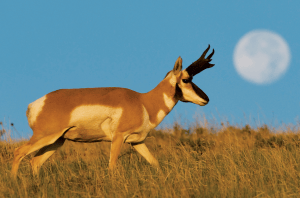
Though not actually an antelope, it is known in north Americas as the American antelope, prong buck, pronghorn antelope and prairie antelope
It resembles the antelope and fills a similar ecological niche. It is the only surviving member of the family Antilocapridae.
About 11 antilocaprid species existed in North America during the pleistocene (1). And, there were three other genera (capromeryx (2),(3), stockoceros (4),(5), and tetrameryx (6)) but they are now extinct
As member of the superfamily giraffoidea, the pronghorn’s closest living relatives are the giraffe and okapi (7). Giraffoidea are members of the infraorder pecora. Making pronghorns distant relatives of the cervidae (deer), and bovidae (cattle, goats, sheep, antelopes, and gazelles).
The pronghorn is the fastest land mammal in the western hemisphere, with running speeds of up to 90 km/h (55 mph)
It is featured on the symbol of the American society of mammalogists.
Prior to the arrival of the Europeans, the pronghorn was particularly abundant in the region of the plains indians and region of northwest plateau
Because of its speed looks and maneuvers. It was featured prominently in Native American mythology and history.
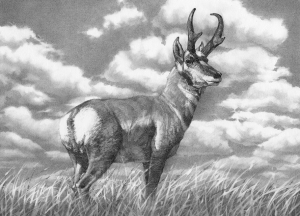
First detailed description 1805-1806:
Exploring the mid west, following the discovery of a few subspecies of the sharp-tailed grouse, captain Meriwether Lewis and second Lieutenant William Clark came across the pronghorn near the mouth of the Niobrara River, in present-day Nebraska.
Some of the indians near the rocky mountains used to hunt these animals on horseback, and shoot them with arrows
Another method they used was to form a large, strong pen or fold in. From which a fence is made of trees and bushes. Gradually widening on each side. The animals are surrounded by the hunters, and they use the tree bushed fence pen move in and surround them. Pronhorns find themselves enclosed, and at the mercy of the hunters.

Habitat:
Pronghorns prefer open, expansive terrain at elevations varying between 3,000 and 5,900 ft. Densest populations in areas receiving around 10–15.5 inches of rainfall per year.
They eat a wide variety of plant foods, including plants unpalatable or toxic to domestic livestock, though they also compete with them for food
A couple studies showed: forbs comprised 62% of their diet, shrubs 23%, and grasses 15%; while another, cacti 40%, grass 22%, forbs 20%, and shrubs 18%.
Pronghorns also chew and eat (ruminate)
Healthy pronghorn populations tend to stay within 3–4 mi of a water source.

Behaviour:
They can run 35 mph 4 mi, 68 km/h (40 mp/H) for 1 mi, and 88.5 km/h (55 mph) for 800 m or 1 ⁄ 2 mi. While it is often cited as the second-fastest land animal, second only to the African cheetah, it can sustains high speeds longer.
Pronghorns may have evolved there running thousands of years ago escaping from now-extinct predators such as the American cheetah
There large windpipe, heart, and lungs allow it to take in large amounts of air when running. Additionally, pronghorn hooves have two long, cushioned, pointed toes which help absorb shock when running at high speeds.
They have an extremely light bone structure and hollow hair
They are not built for jumping though. Since their ranges are sometimes affected by ranchers’ fences, they can be seen going under fences, sometimes at high speed. For this reason wildlife foundations are in the process of removing the bottom barbed wire fences.
Range and ecology:
Present-day range of the pronghorn extends from southern Saskatchewan and Alberta, Canada south into the United States through Montana, Idaho, Utah, Nevada, Arizona, Nebraska, Wyoming, Colorado, New Mexico, Washington, and central Texas. West to coastal southern California and northern Baja California Sur, and Sonora and San Luis Potosí in northern Mexico. Formally they had been found in Iowa and Minnesota in the United States and from Manitoba in Canada.
A subspecies known as the Sonoran pronghorn (A. a. sonoriensis) occurs in Arizona and Mexico. Other subspecies include the Mexican pronghorn (A. a. mexicana), the Oregon pronghorn (A. a. oregona), and the critically endangered Baja California pronghorn (A. a.peninsularis).
Subspecies
Endangerment, and predators:
Recovery plans are in place for sonoran pronghorn (Mexico); and, peninsula pronghorn in Baja California.

Social behavior and reproduction:
Pronghorns form mixed-sex herds in the winter. In early spring, the herds break up. Young males form bachelor groups. Females form harems. And, adult males live solitarily.
Adult males either defend a fixed territory that females may enter, or defend a harem and females.
Biology:
The pronghorn was first officially described by American ornithologist George Ord in 1815.
Pronghorns have a gestation period of 7–8 months, which is longer than typical north American ungulates. Typically they breed in mid-September, and the doe carries her fawn until late May. Sexual maturity is reached at 15 to 16 months, though males rarely breed until three. Natural lifespan is 8-15 years.

While sabretooth cats, american lions, scimitars, direwolfs, and even flat nosed bears would have preyed upon the pronghorn before the pleistocene epoch
Cougars (puma concolor), wolves (canis lupus), coyotes (canis latrans), grizzly bears (ursus arctos horribilis) and bobcats (lynx rufus) are major predators of pronghorns. Golden eagles (Aquila chrysaetos) have been reported to prey on fawns. Jaguars (Panthera onca) also likely prey on pronghorns in their native range in the southwestern United States and in northern Mexico.
All pronghorns require permits, or approval to trap or hunt. If they are charging. Run, hide; or, prepare quickly. Now you know.
Cite: 1) Smithsonian Institution. North American Mammals: Pronghorn Antilocapra americana (http://www.mnh.si.edu/mna/image_info.cfm?species_id=7)
2) Capromeryx furcifer Matthew 1902″ (http://www.fossilworks.org/cgi-bin/bridge.pl?a=taxonInfo&taxon_no=44915). Paleobiology Database. Retrieved
3) “Capromeryx minor Taylor 1911” (http://www.fossilworks.org/cgi-bin/bridge.pl?a=taxonInfo&taxon_no=44919). Paleobiology Database.
4) “Stockoceros conklingi Stock 1930” (http://www.fossilworks.org/cgi-bin/bridge.pl?a=taxonInfo&taxon_no=51821). Paleobiology Database.
5) “Stockoceros onusrosagris Roosevelt and Burden 1934” (http://www.fossilworks.org/cgi-bin/bridge.pl?a=taxonInfo&taxon_no=51822). Paleobiology Database.
6) “Tetrameryx shuleri Lull 1921” (http://www.fossilworks.org/cgi-bin/bridge.pl?a=taxonInfo&taxon_no=52226). Paleobiology Database.
7) Upham, N.S.; Esselstyn, J.A.; Jetz, W. (2019). “Inferring the mammal tree: Species-level sets of phylogenies for questions in ecology, evolution, and conservation” (https://www.ncbi.nlm.nih.gov/pmc/articles/PMC6892540). PLOS
Biology. 17 (12): e3000494. doi:10.1371/journal.pbio.3000494 (https://doi.org/10.1371%2Fjournal.pbio.3000494). PMC 6892540 (https://www.ncbi.nlm.nih.gov/pmc/articles/PMC6892540). PMID 31800571 (https://pubmed.ncbi.nlm.nih.gov/31800
571). See Fig. S10 in Supplementary Information.
Bibliography: Grubb, P. (2005). “Order Artiodactyla”. In Wilson, D.E.; Reeder, D.M (eds.). Mammal Species of the World: A Taxonomic and Geographic Reference (3rd ed.). Johns Hopkins University Press. pp. 671–2. ISBN978-0-8018-8221-0. OCLC62265494.
Woodger, E.; Toporov, B. (2004). Encyclopedia of the Lewis and Clark Expedition. New York, USA: Facts On File. pp. 31–2. ISBN978-1-4381-1023-3.
Pronghorn” in The Encyclopedia of Mammals David MacDonald (ed.) Oxford University Press pp. 528-529 ISBN 0816064946.
Caton, J. D. (1876). “The American Antelope, or Prong Buck”. The American Naturalist. 10 (4): 193–205. doi:10.1086/271628. JSTOR2448724.
Leave a Reply