< home # store # services # articles # game # app #contact >
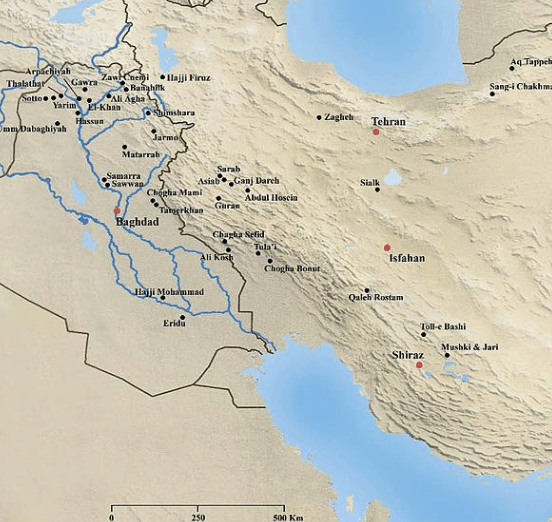

An important archaeological site dating back to the neolithic period called Ali Kosh exists
It is a significant site for the study of ancient human history and the development of early civilizations. Dating back 9500 years ago, or 7500BC. (1)

Located as a small tell, on the semi-arid Deh Luran plain, near a seasonal marsh
It was excavated by Frank Hole and Kent Flannery in the 1960s
The site is about 135 m in diameter. (1)
In addition to information on agriculture and the gathering of wild plants, the sites contained abundant evidence of developing livestock management
Originally occupied by pre-pottery peoples (2)

Ali Kosh architecture
The site contains the remains of ancient architectural structures, including mudbrick buildings and fortifications.
Three occupational phases have been identified
Bus Mordeh phase started around 7500 BC
The settlement began as a group of small, rectangular houses with several rooms made of rammed earth. The occupants develop an economy based on the herding of sheep, goats, hunting and gathering wild plants.
Ali Kosh phase was around 7250 to 7000 BC
Noted larger houses, and the deceased buried under floors. With sometimes gracious burial gifts. The economy begins to show more intense agriculture. Including support from fishing and shell fishing. And, possibly a sign of status. Bandages are introduced to children.
Mohammed Jaffar phase is dated 7000 to 6500 BC (3)
The houses become better. Made of stone. A necropolis is established in the nearby area. Stronger tools are made using flint. Polished stone containers are found. And other other tools, including hand mills, mortars, and baskets (lined with pitch) are used.
Ceramics appear during this period. Including decorated vases; and, both human and animal figurines are produced (4)
There are signs of trade. Stronger materials are imported from other areas. Including copper, and turquoise.
During the summer, animal the herds are moved into the highlands


Ali Kosh was the earliest agricultural community in western Iran
Emmer wheat was already cultivated by the eighth millennium BC. This crop was not native to the area. Wild two-row hulled barley was also present. And, Goats and sheep were herded. (5)
Using flotation and water separation sediments. Archaeologists recovered thousands of charred seeds of both local and wild vegetation. Including domestication.
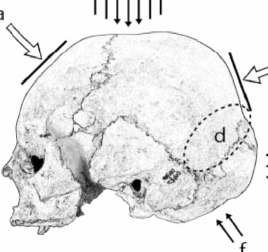
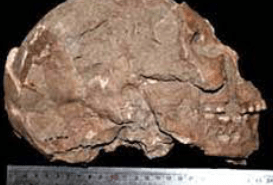
Skull modification: artificial cranial deformation (6)
In 2017, 7 crania were found, all showing the evidence of ritual cranial deformation. Circumferential modification was evident. From what scientists believe was the application of a band wrapped around the cranium. (7)(8) It was not unheard of. Previously, similar crania were already excavated in the area by Hole and Flannery.


Ritual tooth avulsion
Another cultural practice observed by archaeologist was removal of one or more teeth. Such a practice was quite common around the world in ancient times. (9) According to researchers, it was common in north Africa (10) and, the Natufian culture. (11) But, had not been seen in the eastern fertile crescent. (12)
Archaeological evidence at Ali Kosh suggests the presence of a increasing economic, and social structures. The site has contributed to our understanding of early urbanization and the development of complex societies in the ancient Near East. It offers insights into the transition from smaller, village-based communities. To a more centralized and organized urban center. Ali Kosh is an important piece of the puzzle in our understanding of human history in this region.

Cite: 1) Smith, Andrew Brown (2005). African herders: emergence of pastoral traditions (https://books.google.com/books?id=OrLWtk0QXRYC&pg=PA68). Rowman Altamira. pp. 67–68.ISBN 978-0-7591-0748-9.
2) Langer, William L. (1972). An Encyclopedia of World History (5th ed.). Boston, MA: Houghton Mifflin Company. p. 17 (https://archive.org/details/encyclopediaworl00will/page/17).
ISBN 0-395-13592-3. LCCN 72186219 (https://lccn.loc.gov/72186219).
3) Darabi, H. (2018). ‘Revisiting Stratigraphy of Ali Kosh, Deh Luran Plain’, Pazhoheshha-ye Bastan shenasi Iran, 8(16), pp. 27-42. doi:10.22084/nbsh.2018.14908.1661 (https://doi.org/
10.22084%2Fnbsh.2018.14908.1661)
4) Darabi, H. (2018). ‘Revisiting Stratigraphy of Ali Kosh, Deh Luran Plain’, Pazhoheshha-ye Bastan shenasi Iran, 8(16), pp. 27-42. doi:10.22084/nbsh.2018.14908.1661 (https://doi.org/
10.22084%2Fnbsh.2018.14908.1661)
5) Mukhtar Ahmed, Ancient Pakistan – An Archaeological History: Volume II: A Prelude to Civilization. (https://books.google.com/books?id=HbvTBAAAQBAJ&pg=PA214) 2014, pg. 214-215
6) Frieß & Baylac 2003, Exploring artificial cranial deformations using elliptic fourier analysis of procuste aligned outcomes, American journal physical anthropology user
7) Meiklejohn et al. 1992; Daems & Croucher 2007, Artifical cranial modification, evidence from prehistoric Iran crania & figurines
8) Arkadiusz Sołtysiak*1, Hojjat Darabi, Human remains from Ali Kosh, Iran, 2017. (http://www.anthropology.uw.edu.pl/11/bne-11-05.pdf) Bioarchaeology of the Near East, 11:76–83 (2017) Short fieldwork report.
9) Pinchi, Vilma; Barbieri, Patrizia; Pradella, Francesco; Focardi, Martina; Bartolini, Viola; Norelli, Gian-Aristide (2015). “Dental Ritual Mutilations and Forensic Odontologist Practice: a Review of the Literature” (https://www.ncbi.nlm.nih.gov/pmc/articles/PMC4945
341). Acta Stomatologica Croatica. 49 (1): 3–13. doi:10.15644/asc49/1/1 (https://doi.org/10.15644%2Fasc49%2F1%2F1). ISSN 0001-7019 (https://www.worldcat.org/issn/0001-7019).
PMC 4945341 (https://www.ncbi.nlm.nih.gov/pmc/articles/PMC4945341). PMID 27688380 (https://pubmed.ncbi.nlm.nih.gov/27688380).
10) Stojanowskiet al. 2014; De Groote & Humphrey 2016
11) Arkadiusz Sołtysiak, Hojjat Darabi, Human remains from Ali Kosh, Iran, 2017. (http://www.
anthropology.uw.edu.pl/11/bne-11-05.pdf) Bioarchaeology of the Near East, 11:76–83
(2017) Short fieldwork report.
12) Arkadiusz Sołtysiak, Hojjat Darabi, Human remains from Ali Kosh, Iran, 2017. (http://www.
anthropology.uw.edu.pl/11/bne-11-05.pdf) Bioarchaeology of the Near East, 11:76–83 (2017) Short fieldwork report.
Bibliography: Darvill, Timothy (2008). The Concise Oxford Dictionary of Archaeology (http://www.oxfordreference.com/view/10.1093/oi/authority.20110803095402701) (2nd ed.). Oxford Reference. doi:10.1093/acref/9780199534043.001.0001 (https://doi.org/10.1093%2Facref%2F9780199534043.001.0001). ISBN 9780191727139
Hole, Frank. “Ali Kosh” (http://campuspress.yale.edu/frankhole/ali_kosh/). Yale Campus Press. Yale University
Darabi, H. (2018). ‘Revisiting Stratigraphy of Ali Kosh, Deh Luran Plain’, Pazhoheshha-yeBastan shenasi Iran, 8(16), pp. 27-42. doi:10.22084/nbsh.2018.14908.1661 (https://doi.org/10.22084%2Fnbsh.2018.14908.1661)
Hole F., Flannery K.V., Neely J.A. (1969), Prehistory and human ecology of the Deh Luran plain. An early village sequence from Khuzistan, Iran, Ann Arbor: University of Michigan.
Pinchi, Vilma; Barbieri, Patrizia; Pradella, Francesco; Focardi, Martina; Bartolini, Viola; Norelli, Gian-Aristide (2015). “Dental Ritual Mutilations and Forensic Odontologist Practice: a Review of the Literature” (https://www.ncbi.nlm.nih.gov/pmc/articles/PMC4945 341). Acta Stomatologica Croatica. 49 (1): 3–13. doi:10.15644/asc49/1/1 (https://doi.org/10.15644%2Fasc49%2F1%2F1). ISSN 0001-7019 (https://www.worldcat.org/issn/0001-7019.PMC) 4945341 (https://www.ncbi.nlm.nih.gov/pmc/articles/PMC4945341). PMID 27688380(https://pubmed.ncbi.nlm.nih.gov/27688380).
Leave a Reply