< home # store # services # articles # game # app #contact >


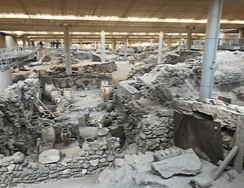
Sleeping volcanos
There is a variety of evidence about the eruption that destroyed prehistoric Akrotiri. It probably occurred between 1620 and 1530 BC.
It was a small fishing and farming village. The earliest neolithic evidence in Akrotiri can be traced back as early as the fifth millennium BC
As evidenced by pottery at the site, by the 3rd millennium BC, this community was thriving. Its growth begin neolithically with trade relations, in agriculture, farming, and pottery. And, its strategic position on the sailing route between Cyprus and Minoan Crete. It was an important trade point. As proven by the paved streets and extensive drainage system. Paintings, pottery, furniture, and even a three-story building have been discovered at the site. With all of this, Akrotiri was able to prosper.
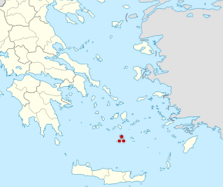
The Akrotiri site is on the Greek island of Santorini.
F Fouque begain archaeological excavations in 1867
Extensive modern excavation was started in 1967 by Spyridon Marinatos. For the archaeologists (many of whom had no experience with volcanically burried cities), life became extremely challenging. Akrotiri in the Bronze age was revealed.
Did you know? Records in material cultures, and unusual growth patterns of tree rings actually suggest there could have been multiple volcanic eruptions.
Frescoes are paintings and sculptures. They are done with paint, on a plaster wall or ceiling that is drying. So the colours penetrate the plaster and become fixed, as it dries
The frescoes in Akrotiri are important for the study of art, because they are well preserved. Almost of all the other paintings from this age are broken, and in small pieces. Paintings at Akrotiri include beautiful white, yellow, red, brown, blue and black colors. Popular Frescoes found standing included ‘the Fisherman’ and, ‘the Lady from the House of Ladies’. (1)(2)
Pottery was significant
Volcanic eruptions happen quick. Because people needed to get out, meant they could only take most valuable possessions. At Akrotiri, a lot of pottery was left behind.
Archaeologists found jars and containers for preparing and cooking food, eating and drinking and many others. Some of the fancier pottery there included: bathtubs, braziers, oil lamps, bee-hives, and flower pots. Things like stirrup jars that were used for transportation were even left behind.

Nowadays Akrotiri still connects the prehistoric and modern world. There is a a cool mountain bike, and hiking path from the modern settlement to the parking lot of excavations. And, you can still check it out today.
Citations: 1) Cyron, M. (2014, March 25). Fisherman Fresco, Akrotiri. World History Encyclopedia. Retrieved from https://www.worldhistory.org/image/2442/fisherman-fresco-akrotiri/
2) Cartwright, M. (2014, March 24). House of the Ladies Fresco, Akrotiri. World History Encyclopedia. Retrieved from https://www.worldhistory.org/image/2439/house-of-the-ladies-fresco-akrotiri/
Bibliography: Pearson, Charlotte; Brewer, Peter; Brown, David; Heaton, Timothy; Hodgkins, Gregory; Jull, Timothy; Lange, Todd; Salzer, Matthew (2018). “Annual radiocarbon record indicates 16th century BCE date for the Thera eruption”. Science Advances. 4 (8): eaar8241.
Akrotiri Museum. (n.d.). Akrotiri Museum – Santorini. https://akrotiri-museum.com/
Doumas, Christos G. (1983). Thera, Pompeii of the Ancient Aegean: Excavations at Akrotiri 1967-1979. London: Thames and Hudson.
Christos G. Doumas, The Wall Paintings of Thera, Athens 1991
Leave a Reply